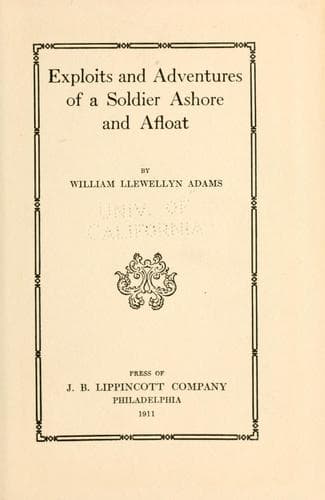
Exploits and adventures of a soldier ashore and afloatAdams, William Llewellyn
History
Exploits and adventures of a soldier ashore and afloat
Adams, William Llewellyn
Adams, William Llewellyn; Americans -- Foreign countries; United States. Army -- Military life
Cock-fighting in the Philippines is honest sport; there is no such
thing as throwing the game as in a prize-fight, or pulling a horse as
in racing. The fowls are usually so evenly matched that there is
little of advantage in either one, from which to choose a preference,
the book-makers in almost every case relying on their good fortune.
These mains are the most popular sport in the islands, and, in
consequence of the honest methods of the promoters in conducting them,
have been carried on for ages without cessation or municipal
interference, such as is sometimes waged against bull-fighting,
horse-racing, and prize-fighting in other countries.
The very atmosphere of the Philippines attracts you to these large
nippa and bamboo arenas, and it seems you involuntarily follow the
procession here as you would the race-track following in New Orleans
or the daily crowd that gather to witness “Cuban pelota” in Havana. It
is the antique axiom exemplified: “When in Rome do as the Romans do.”
XIV.
Departure of the 29th Infantry from the Philippines
Brigade Headquarters, Ft. Wm. McKinley――Afloat on the Pásig
River――Quarantine at Mariveles――Liberty in Japan――Across the
Pacific――Reception in Honolulu――Greetings in “Frisco”――Via Santa
Fé to Governor’s Island.
It was midday in August, 1909, when the long chain of cascoes and
steam-launches loaded with the three battalions and band of the
Twenty-ninth Infantry swung into the rapids of the Pásig River to the
strains of that dear old Southern melody, “My Old Kentucky Home,”
leaving, as we floated with the current, many a heart-broken “mestizo”
with her bandanna soaked in tears, wafting adieu to her “Americano
soldado,” with whom she had had her last glide in the dance-halls of
Guadeloupe. After a campaign of two years in a brigade post under the
burning sun of the tropics, the course of our homeward-bound journey
had begun on the historical old Pásig River, which, could it voice its
history, might tell many a weird tale of adventure and bloody
struggle.
The military rendezvous and scene of our departure was Fort William
McKinley, situated on a plateau near the Pásig and Tagigue Rivers,
overlooking the broad bay and city of Manila on the west, and the
beautiful lake in the district of Laguna de Bay on the east. In close
proximity was a branch line of the Manila and Dagupán Railroad,
connecting the provincial territory between Manila and the village of
Antipolo. In addition to the steam-train, a trolley system covered the
government reservation, terminating in the barrio of Pásig.
Public-domain text, read in full here on John Shaqi.
Reviews
Reviews
No reviews yet
Be the first to share your thoughts on this work.
Elsewhere in the archive
Join the Discussion
Join the discussion
Sign in to leave a comment or review.
Sign InorCreate an account