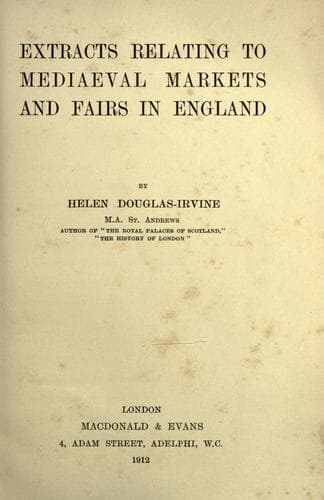
Extracts Relating to Mediaeval Markets and Fairs in EnglandDouglas-Irvine, Helen
History
Extracts Relating to Mediaeval Markets and Fairs in England
Douglas-Irvine, Helen
Fairs; Great Britain -- History -- Sources; Markets -- England
In that part are the sumpter horses, powerful and spirited; here costly
chargers elegant of form, noble of stature, with ears quickly
tremulous, necks lifted, haunches plump. In their stepping the buyers
first try for the gentler, then for the quicker pace, which is by the
fore and the hind feet moving in pairs together. When a race is ready
for such thunderers, and perhaps for others of like kind, powerful to
carry, quick to run, a shout is raised, orders are given that the
common horses stand apart. The boys who mount the wing-footed, by twos
or threes, according to the match, prepare themselves for contest;
skilled to rule horses, they restrain the mouths of the untrained with
bitted bridles. For this chiefly they care, that no one should get
before another in the course. The horses rise too in their own way to
the struggle of the race; their limbs tremble, impatient of delay they
cannot keep still in their place; at the sign given their limbs are
stretched, they hurry on their course, are borne with stubborn speed.
The riders contend for the love of praise and hope of victory, plunge
spurs into the loose-reined horses, and urge them none the less with
whips and shouts. You would think with Heraclitus everything to be in
motion, and the opinion to be wholly false of Zeno, who said that there
was no motion and no goal to be reached. In another part of the field
stand by themselves the goods proper to rustics, implements of
husbandry, swine with long flanks, cows with full udders, oxen of bulk
immense, and woolly flocks. There stand the mares fit for plough, dray
and cart, some big with foal, and others with their young colts closely
following.
William Fitzstephen, _Description of the Most Noble City of
London_, prefixed to his _Life of Thomas à Becket_. (Translation by
H. Morley, prefatory to his edition of Stow's _Survey of London_.)
[4] "Prance high, and rear their supple necks."
From Virgil's _Georgics_.
SPECIAL PRIVILEGES.
In some cases the king gave his special protection to markets and
fairs.
1133. _Charter of Henry I. to the Priory of St. Bartholomew, Smithfield._
I give my firm peace to those who come to the fair which is wont to be
held on the feast of St. Bartholomew in that place (Smithfield), and to
those who go thence; and I command that no royal servant implead them,
nor exact from those who come customs, without the consent of the
canons, on these three days, on the eve of the feast, on the feastday,
and on its morrow.
Printed in Dugdale, _Monasticon_, VI. 296.
_Charter of Henry II. to the burghers of Nottingham._
... Moreover all who come to the market of Nottingham shall not suffer
distraint, from Friday evening until Sunday evening, except for the
king's farm.
Stubbs, _Select Charters_, 167.
PIED POUDRE COURTS.
Public-domain text, read in full here on John Shaqi.
Reviews
Reviews
No reviews yet
Be the first to share your thoughts on this work.
Join the Discussion
Join the discussion
Sign in to leave a comment or review.
Sign InorCreate an account