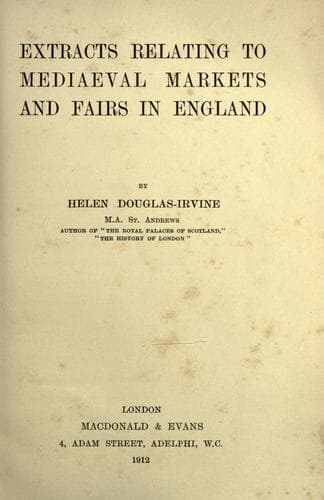
Extracts Relating to Mediaeval Markets and Fairs in EnglandDouglas-Irvine, Helen
History
Extracts Relating to Mediaeval Markets and Fairs in England
Douglas-Irvine, Helen
Fairs; Great Britain -- History -- Sources; Markets -- England
Here is made known in this writing how King Edgar renewed the liberty
of Taunton, for the Holy Trinity and St. Peter and St. Paul, to the
episcopal see of Winchester, as King Edward had before freed it, ...;
and let the town's market and the produce of the town-dues go to the
holy place, as they did before, in the days of my forefathers, and were
levied for Bishop Aelfeah and every one of those who enjoyed the land.
Whoever will increase this liberty, may God increase his prosperity in
a long life here and in eternity. But if any, through audacity and the
instigation of the devil and his limbs, will violate this liberty or
pervert it to another, unless ere his departure hence he make
reparation, be he with malediction cut off from the communion of our
Lord and all his saints, and ever be tormented in hell torture, with
Judas who was Christ's betrayer.
Thorpe, _Diplomatarium Anglicium Aevi Saxonici_, 235.
_Circa 901-21. Law of Edward and Guthrum._
If any man engage in Sunday marketing, let him forfeit the chattel, and
twelve ores among the Danes, and thirty shillings among the English.
Thorpe, _Ancient Laws and Institutes_, 73.
_Circa 1020. Charter of Canute._
We admonish that men keep Sunday's festival with all their might, and
observe it from Saturday's noon to Monday's dawning; and no man be so
bold that he either go to market or seek any court on that holy day.
Stubbs, _Select Charters_, 76.
_N.B.--These latter enactments were chiefly distinguished by their
breach, for throughout the middle ages English markets were frequently
held on Sunday. They were probably abortive attempts on the part of
pious legislators to end a custom which seemed to them ungodly._
EFFECT OF THE CONQUEST.
In Domesday Book there is evidence of a considerable number of markets
which had existed in England under Edward the Confessor, and which
usually yielded to their holders an annual profit of from 20s. to 40s.,
in those days large sums of money. New markets were in some cases
established by the Norman lords who acquired English lands, and they
tended to disorganise the market economy.
1087. _The ruin of the bishop's market at St. Germans._
The bishop has a lordship called St. Germans. In that lordship, on the
day on which King Edward lived and died, there was a market held on
Sunday. And now it is made nothing by the market set up close at hand
by the count of Mortain in his castle, on the same day.
_Exon. Domesday_ (Rec. Com.), 182, 470.
1087. _Necessity to change the day of the market at Hoxne in Suffolk._
Public-domain text, read in full here on John Shaqi.
Reviews
Reviews
No reviews yet
Be the first to share your thoughts on this work.
Join the Discussion
Join the discussion
Sign in to leave a comment or review.
Sign InorCreate an account