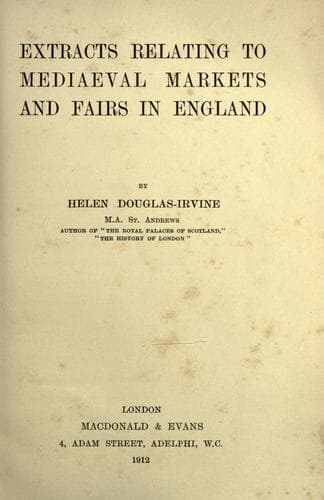
Extracts Relating to Mediaeval Markets and Fairs in EnglandDouglas-Irvine, Helen
History
Extracts Relating to Mediaeval Markets and Fairs in England
Douglas-Irvine, Helen
Fairs; Great Britain -- History -- Sources; Markets -- England
1222. THE KING TO THE SHERIFF OF SOMERSET GREETING.
We have heard that a market has been newly established without warrant
at Wechat to the detriment of the market of Dunster. And therefore we
command you that if so it be, then without delay you cause such market
to be forbidden, so that for the future no market be there held to the
detriment of the market of Dunster.
_Cal. Rot. Lit. Claus._ (Rec. Com.), I. 527b.
MARKET-PLACES.
Markets and fairs were held sometimes in open and outlying places, as
at Smithfield; but more frequently in central parts of their towns--in
graveyards, in the market-places of which many survive, and in the
streets. The last case has named streets in many English towns "Cheap"
or "Cheapside," for "cheap" meant "market."
1223. THE KING TO THE MAYOR AND BAILIFFS OF LINCOLN GREETING.
We command you that on our behalf you cause to be forbidden that any
market be held in future at Lincoln in the graveyards, but that the
markets be held in the streets of that city, where best and most
adequately you shall provide that they be.
_Cal. Rot. Lit. Claus._ (Rec. Com.), I. 547.
1233. The king has granted to Hamo de Crevecquer that the market, which
has been used to be held every week on Sunday at Brenchley in the
graveyard of the church, be held henceforth on the land of Hamo of
Brenchley, and that he and his heirs have there every year a fair to
last three days, the vigil, the day and the morrow of the feast of All
Saints. And the sheriff of Kent is commanded to cause that market and
the fair to be proclaimed, and to be held as aforesaid.
_Cal. of Close_, 1231-4, 234.
1234. The king has granted to the prior and the brethren of the bridge
of Lechlade that they have for ever at Lechlade bridge every year a
fair, to last for five days, the eve and the feastday of the
Decollation of St. John the Baptist and the three following days.
_Cal. of Close_, 1231-4, 398.
1235. The king has conceded to Henry, Abbot of St. Edmund, that he and
his successors have yearly for ever two fairs in the suburb of the town
of (Bury) St. Edmunds, namely one outside the north gate, outside the
town, beside the hospital of St. Saviour, to last for three days, the
eve, the day, and the morrow of the feast of the Transfiguration of the
Lord; and another outside the south gate of the town, likewise to last
for three days, the eve, the day, and the morrow of the feast of the
Translation of St. Edmund: unless such fairs be to the injury of
neighbouring fairs. And the sheriff is commanded to cause this charter
to be read in full county court, and these fairs to be proclaimed and
held.
_Cal. of Close_, 1234-7, 61.
Encroachments on market-places were not lawful without special licence.
1123. _Foundation of the Priory of St. Bartholomew on part of
Smithfield market-place by Rahere, first prior._
Public-domain text, read in full here on John Shaqi.
Reviews
Reviews
No reviews yet
Be the first to share your thoughts on this work.
Join the Discussion
Join the discussion
Sign in to leave a comment or review.
Sign InorCreate an account