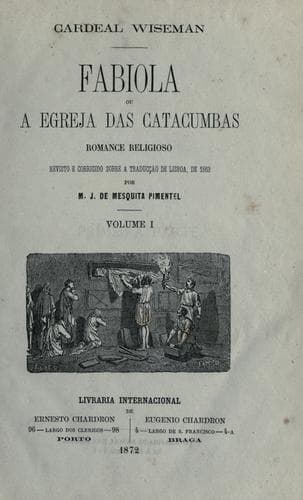
Fabiola; Or, The Church of the CatacombsWiseman, Nicholas Patrick
HistoryHistory
Fabiola; Or, The Church of the Catacombs
Wiseman, Nicholas Patrick
Christian fiction; Church history -- Primitive and early church, ca. 30-600 -- Fiction; Historical fiction
A native of Fundi, he had started the school in Rome, with which we
became acquainted at an early period of our history, and had proved
eminently successful. But finding a persecution imminent, and his
Christianity discovered, he had disposed of his school and retired to
his small native town, where he was promised, after the vacation, the
children of the principal inhabitants. In a fellow-Christian he saw
nothing but a brother; and as such he talked freely with him, of his
past adventures and his future prospects. A strange idea dashed through
the mind of Torquatus, that some day that information might be turned
into money.
It was still early when Torquatus took his leave, and, pretending to
have some business in the town, he would not allow his host to accompany
him. He bought himself some more respectable apparel, went to the best
inn, and ordered a couple of horses, with a postillion to accompany him;
for, to fulfill Fabiola’s commission it was necessary to ride forward
quick, change his horses at each relay, and travel through the night. He
did so till he reached Bovillæ, on the skirts of the Alban hills. Here
he rested, changed his travelling suit, and rode on gaily between the
lines of tombs, which brought him to the gate of that city, within whose
walls there was more of good and more of evil contained, than in any
province of the empire.
[Illustration: The Peacock, as an Emblem of the Resurrection.]
CHAPTER XIX.
THE FALL.
Torquatus, now elegantly attired, proceeded at once to the house of
Fabius, delivered his letter, answered all inquiries, and accepted,
without much pressing, an invitation to supper that evening. He then
went to seek a respectable lodging, suited to the present state of his
purse; and easily found one.
Fabius, we have said, did not accompany his daughter into the country,
and rarely visited her there. The fact was, that he had no love for
green fields or running brooks; his tastes were for the gossip and free
society of Rome. During the year, his daughter’s presence was a
restraint on his liberty; but when she was gone, with her establishment,
into Campania, his house presented scenes and entertained persons, that
he would not have presumed to bring in contact with her. Men of
profligate life surrounded his table; and deep drinking till late hours,
with gambling and loose conversation, generally followed his sumptuous
entertainments.
Having invited Torquatus to sup with him, he went forth in search of
guests to meet him. He soon picked up a batch of sycophants, who were
loitering about his known haunts, in readiness for invitations. But as
he was sauntering home from the baths of Titus, he saw two men in a
small grove round a temple earnestly conversing together. After a
moment’s look, he advanced towards them; but waited, at a small
distance, for a pause in the dialogue, which was something to this
effect.
“There is no doubt, then, about the news?”
Public-domain text, read in full here on John Shaqi.
Reviews
Reviews
No reviews yet
Be the first to share your thoughts on this work.
Elsewhere in the archive
Join the Discussion
Join the discussion
Sign in to leave a comment or review.
Sign InorCreate an account