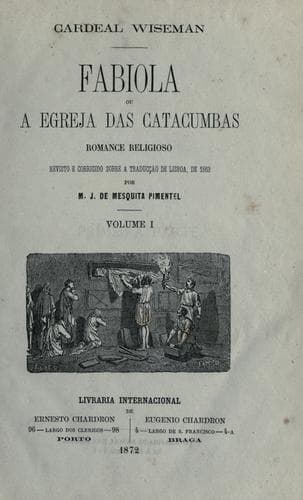
Fabiola; Or, The Church of the CatacombsWiseman, Nicholas Patrick
HistoryHistory
Fabiola; Or, The Church of the Catacombs
Wiseman, Nicholas Patrick
Christian fiction; Church history -- Primitive and early church, ca. 30-600 -- Fiction; Historical fiction
Once upon a time there was a bold young fisherman living on the coast of
southern Italy. One night, stormy and dark, he found that his father and
brothers would not venture out in their tight and strong smack; so he
determined, in spite of every remonstrance, to go alone in the little
cockle-shell attached to it. It blew a gale, but he rode it out in his
tiny buoyant bark, till the sun rose, warm and bright, upon a placid,
glassy sea. Overcome by fatigue and heat, he fell asleep; but, after
some time, was awakened by a loud shouting at a distance. He looked
round and saw the family-boat, the crew of which were crying aloud, and
waving their hands to invite him back; but they made no effort to reach
him. What could they want? what could they mean? He seized his oars, and
began to pull lustily towards them; but he was soon amazed to find that
the fishing-boat, towards which he had turned the prow of his skiff,
appeared upon his quarter; and soon, though he righted his craft, it was
on the opposite side. Evidently he had been making a circle; but the end
came within its beginning, in a spiral curve, and now he was commencing
another and a narrower one. A horrible suspicion flashed upon his mind:
he threw off his tunic and pulled like a madman at his oars. But though
he broke the circle a bit here and a bit there, still round he went, and
every time nearer to the centre, in which he could see a downward
funnel of hissing and foaming water. Then, in despair, he threw down his
oars, and standing he flung up his arms frantically; and a sea-bird
screaming near, heard him cry out as loud as itself, “Charibdis!”[69]
And now the circle his boat went spinning round was only a few times
longer than itself, and he cast himself flat down, and shut his ears and
eyes with his hands, and held his breath, till he felt the waters
gurgling above him, and he was whirled down into the abyss.
“I wonder,” Torquatus said to himself, “did any one ever perish in this
way? or is it a mere allegory?--if so, of what? Can a person be drawn on
gradually in this manner to spiritual destruction? are my present
thoughts, by any chance, an outer circle, which has caught me, and----”
“Fundi!” exclaimed the muleteer, pointing to a town before them; and
presently the mule was sliding along the broad flags of its pavement.
Torquatus looked over his letters, and drew one out for the town. He was
taken to a little inn of the poorest class, by his guide, who was paid
handsomely, and retired swearing and grumbling at the niggardliness of
the traveller. He then inquired the way to the house of Cassianus, the
school-master, found it, and delivered his letter. He received as kind a
welcome as if he had arrived at home; joined his host in a frugal meal,
during which he learned the master’s history.
Public-domain text, read in full here on John Shaqi.
Reviews
Reviews
No reviews yet
Be the first to share your thoughts on this work.
Elsewhere in the archive
Join the Discussion
Join the discussion
Sign in to leave a comment or review.
Sign InorCreate an account