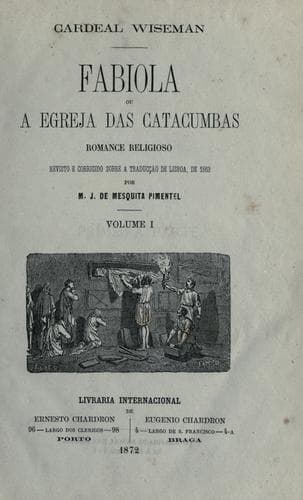
Fabiola; Or, The Church of the CatacombsWiseman, Nicholas Patrick
HistoryHistory
Fabiola; Or, The Church of the Catacombs
Wiseman, Nicholas Patrick
Christian fiction; Church history -- Primitive and early church, ca. 30-600 -- Fiction; Historical fiction
If the beautiful alabaster statue, with a bronze head, in the niche
beside the table, had fallen forward, and been smashed on the marble
pavement, it could not have caused a more fearful sensation than this
sudden announcement. All were startled for a moment. Next, a long blank
pause ensued, after which, each began to show his feelings in his
features. Fabius looked exceedingly foolish, as if conscious that he had
brought his guests into bad company. Calpurnius puffed himself out,
evidently thinking himself ill-used, by having a guest brought in, who
might absurdly be supposed to know more about Christians than himself. A
young man opened his mouth as he stared at Torquatus; and a testy old
gentleman was evidently hesitating, whether he should not knock down
somebody or other, no matter whom. Corvinus looked at the poor Christian
with the sort of grin of delight, half idiotic, half savage, with which
a countryman might gaze upon the vermin that he finds in his trap in a
morning. Here was a man ready to hand, to put on the rack, or the
gridiron, whenever he pleased. But the look of Fulvius was worth them
all. If ever any microscopic observer has had the opportunity of
witnessing the expression of the spider’s features, when, after a long
fast, it sees a fly, plump with others’ blood, approach its net, and
keenly watches every stroke of its wing, and studies how it can best
throw only the first thread round it, sure that then all that gorges it
shall be its own; that we fancy would be the best image of his looks, as
certainly it is of his feelings. To get hold of a Christian, ready to
turn traitor, had long been his desire and study. Here, he was sure, was
one, if he could only manage him. How did he know this? Because he knew
sufficient of Christians to be convinced, that no genuine one would have
allowed himself either to drink to excess, or to boast of his readiness
to court martyrdom.
The company broke up; every body slunk away from the discovered
Christian, as from one pest-stricken. He felt alone and depressed, when
Fulvius, who had whispered a word to Fabius, and to Corvinus, went up to
him, and taking him by the hand said, courteously: “I fear, I spoke
inconsiderately, in drawing out from you a declaration which may prove
dangerous.”
“I fear nothing,” replied Torquatus, again excited; “I will stand to my
colors to the last.”
“Hush, hush!” broke in Fulvius, “the slaves may betray you. Come with me
to another chamber, where we can talk quietly together.”
So saying, he led him into an elegant room, where Fabius had ordered
goblets and flagons of the richest Falernian wine to be brought, for
such as, according to Roman fashion, liked to enjoy a _commissatio_, or
drinking-bout. But only Corvinus, engaged by Fulvius, followed.
Public-domain text, read in full here on John Shaqi.
Reviews
Reviews
No reviews yet
Be the first to share your thoughts on this work.
Elsewhere in the archive
Join the Discussion
Join the discussion
Sign in to leave a comment or review.
Sign InorCreate an account