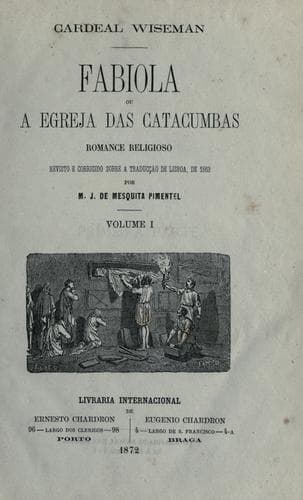
Fabiola; Or, The Church of the CatacombsWiseman, Nicholas Patrick
HistoryHistory
Fabiola; Or, The Church of the Catacombs
Wiseman, Nicholas Patrick
Christian fiction; Church history -- Primitive and early church, ca. 30-600 -- Fiction; Historical fiction
On a beautifully inlaid table were dice. Fulvius, after plying Torquatus
with more liquor, negligently took them up, and threw them playfully
down, talking in the mean time on indifferent subjects. “Dear me!” he
kept exclaiming, “what throws! It is well I am not playing with any one,
or I should have been ruined. You try, Torquatus.”
Gambling, as we learnt before, had been the ruin of Torquatus: for a
transaction arising out of it he was in prison when Sebastian converted
him. As he took the dice into his hand, with no intention, as he
thought, of playing, Fulvius watched him as a lynx might its prey.
Torquatus’s eye flashed keenly, his lips quivered, his hand trembled.
Fulvius at once recognized in all this, coupled with the poising of his
hand, the knowing cast of the wrist, and the sharp eye to the value of
the throw, the violence of a first temptation to resume a renounced
vice.
“I fear you are not a better hand than I am at this stupid occupation,”
said he indifferently; “but, I dare say, Corvinus here will give you a
chance, if you will stake something very low.”
“It must be very low indeed,--merely for recreation; for I have
renounced gambling. Once, indeed--but no matter.”
“Come on,” said Corvinus, whom Fulvius had pressed to his work by a
look.
They began to throw for the most trifling stakes, and Torquatus
generally won. Fulvius made him drink still, from time to time, and he
became very talkative.
“Corvinus, Corvinus,” he said at length, as if recollecting himself,
“was not that the name that Cassianus mentioned?”
“Who?” asked the other, surprised.
“Yes, it was,” continued Torquatus to himself,--“the bully, the big
brute. Were you the person,” he asked, looking up to Corvinus, “who
struck that nice Christian boy Pancratius?”
Corvinus was on the point of bursting into a rage; but Fulvius checked
him by a gesture, and said, with timely interference:
“That Cassianus whom you mentioned is an eminent school-master; pray,
where does he live?”
This he knew his companion wished to ascertain; and thus he quieted him.
Torquatus answered:
“He lives, let me see,--no, no; I won’t turn traitor. No; I am ready to
be burnt, or tortured, or die for my faith; but I won’t betray any
one,--that I won’t.”
“Let me take your place, Corvinus,” said Fulvius, who saw Torquatus’s
interest in the game deepening. He put forth sufficient skill to make
his antagonist more careful and more intent. He threw down a somewhat
larger stake. Torquatus, after a moment’s pause of deliberation, matched
it. He won it. Fulvius seemed vexed. Torquatus threw back both sums.
Fulvius seemed to hesitate, but put down an equivalent, and lost again.
The play was now silent: each won and lost; but Fulvius had steadily the
advantage, and he was the more collected of the two.
Public-domain text, read in full here on John Shaqi.
Reviews
Reviews
No reviews yet
Be the first to share your thoughts on this work.
Elsewhere in the archive
Join the Discussion
Join the discussion
Sign in to leave a comment or review.
Sign InorCreate an account