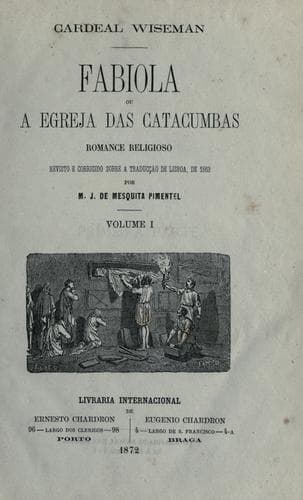
Fabiola; Or, The Church of the CatacombsWiseman, Nicholas Patrick
HistoryHistory
Fabiola; Or, The Church of the Catacombs
Wiseman, Nicholas Patrick
Christian fiction; Church history -- Primitive and early church, ca. 30-600 -- Fiction; Historical fiction
Having sent Corvinus sulky and fretting home, he returned to Torquatus,
whom he wished to accompany, that he might ascertain his lodgings. As
soon as he had left the room, his victim had arisen from his chair, and
endeavored, by walking up and down, to steady his senses and regain
self-possession. But it was in vain; his head was swimming from his
inebriety, and his subsequent excitement. The apartment seemed to turn
round and round, and float up and down; he was sick too, and his heart
was beating almost audibly. Shame, remorse, self-contempt, hatred of his
destroyers and of himself, the desolateness of the outcast, and the
black despair of the reprobate, rolled like dark billows through his
soul, each coming in turn uppermost. Unable to sustain himself longer on
his feet, he threw himself on his face upon a silken couch, and buried
his burning brow in his icy hands, and groaned. And still all whirled
round and round him, and a constant moaning sounded in his ears.
[Illustration: A Dove, as an Emblem of the Soul.]
Fulvius found him in this state, and touched his shoulder to rouse him.
Torquatus shuddered, and was convulsed; then exclaimed: “Can this be
Charybdis?”
[Illustration: Diogenes the excavator, from a painting in the Cemetery
of Domitilla.[71]]
Part Second.--Conflict.
CHAPTER I.
DIOGENES.
The scenes through which we have hitherto led our reader have been laid
in one of those slippery truces, rather than peace, which often
intervened between persecution and persecution. Already rumors of war
have crossed our path, and its note of preparation has been distinctly
heard. The roar of the lions near the Amphitheatre, which startled but
dismayed not Sebastian, the reports from the East, the hints of Fulvius,
and the threats of Corvinus, have brought us the same news, that before
long the horrors of persecution will re-appear, and Christian blood will
have to flow, in a fuller and nobler stream than had hitherto watered
the Paradise of the New Law. The Church, ever calmly provident, cannot
neglect the many signs of a threatened combat, nor the preparations
necessary for meeting it. From the moment she earnestly begins to arm
herself, we date the second period of our narrative. It is the
commencement of conflict.
[Illustration: Jonas, after a painting in the Cemetery of Callistus.]
Public-domain text, read in full here on John Shaqi.
Reviews
Reviews
No reviews yet
Be the first to share your thoughts on this work.
Elsewhere in the archive
Join the Discussion
Join the discussion
Sign in to leave a comment or review.
Sign InorCreate an account