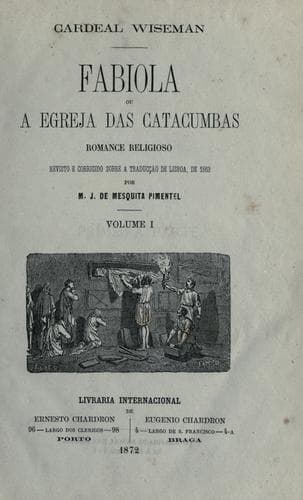
Fabiola; Or, The Church of the CatacombsWiseman, Nicholas Patrick
HistoryHistory
Fabiola; Or, The Church of the Catacombs
Wiseman, Nicholas Patrick
Christian fiction; Church history -- Primitive and early church, ca. 30-600 -- Fiction; Historical fiction
It was towards the end of October that a young man, not unknown to us,
closely muffled up in his cloak, for it was dark and rather chill, might
be seen threading his way through the narrow alleys of the district
called the Suburra; a region, the extent and exact position of which is
still under dispute, but which lay in the immediate vicinity of the
Forum. As vice is unfortunately too often linked with poverty, the two
found a common asylum here. Pancratius did not seem much at home in this
part of the city, and made several wrong turns, till at length he found
the street he was in search of. Still, without numbers on the doors, the
house he wanted was an unsolved problem, although not quite insoluble.
He looked for the neatest dwelling in the street; and
[Illustration: Lazarus raised from the dead. A similar representation is
found in the Catacomb _Inter duos lauros_, and in the Cemetery of Saints
Nereus and Achilles.]
being particularly struck with the cleanliness and good order of one
beyond the rest, he boldly knocked at its door. It was opened by an old
man, whose name has already appeared in our pages, Diogenes. He was tall
and broad-shouldered, as if accustomed to bear burdens, which, however,
had given him a stoop in his gait. His hair was a perfect silver, and
hung down at the sides of a large massive head; his features were
strongly marked in deep melancholy lines, and though the expression of
his countenance was calm, it was solemnly sad. He looked like one who
had lived much among the dead, and was happiest in their company. His
two sons, Majus and Severus, fine athletic youths, were with him. The
first was busy carving, or scratching rather, a rude epitaph on an old
slab of marble, the reverse of which still bore traces of a heathen
sepulchral inscription, rudely effaced by its new possessor.
[Illustration: Two _fossores_, or excavators, from a picture in the
Cemetery of Callistus.]
Pancratius looked over the work in hand and smiled; there was hardly a
word rightly spelt, or a part of speech correct; indeed, here it is:
=DE BIANOBA
POLLECLA QVE ORDEV BENDET DE BIANOBA=[72]
Public-domain text, read in full here on John Shaqi.
Reviews
Reviews
No reviews yet
Be the first to share your thoughts on this work.
Elsewhere in the archive
Join the Discussion
Join the discussion
Sign in to leave a comment or review.
Sign InorCreate an account