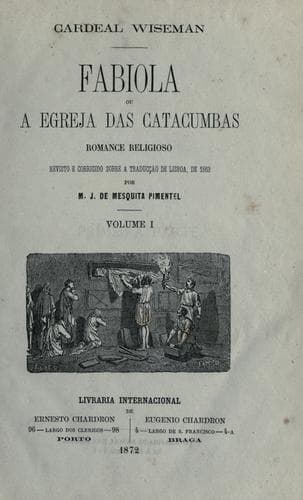
Fabiola; Or, The Church of the CatacombsWiseman, Nicholas Patrick
HistoryHistory
Fabiola; Or, The Church of the Catacombs
Wiseman, Nicholas Patrick
Christian fiction; Church history -- Primitive and early church, ca. 30-600 -- Fiction; Historical fiction
[Illustration: The Martyr’s Widow.]
rendered it necessary to transfer the residence of the Ruler of the
Church, from his ordinary dwelling, to a securer asylum. For this
purpose Lucina’s house was chosen; and it continued to be so occupied,
to her great delight, in that and the following pontificate, when the
wild beasts were ordered to be transferred to it, that Pope Marcellus
might feed them at home. This loathsome punishment soon caused his
death.
Lucina admitted, at forty,[82] into the order of deaconesses, found
plenty of occupation in the duties of her office. The charge and
supervision of the women in church, the care of the sick and poor of her
own sex, the making, and keeping in order of sacred vestments and linen
for the altar, and the instruction of children and female converts
preparing for baptism, as well as the attending them at that sacred
rite, belonged to the deaconesses, and gave sufficient occupation in
addition to domestic offices. In the exercise of both these classes of
duties, Lucina quietly passed her life. Its main object seemed to be
attained. Her son had offered himself to God; and lived ready to shed
his blood for the faith. To watch over him, and pray for him, were her
delight, rather than an additional employment.
Early in the morning of the appointed day, the meeting mentioned in our
last chapter took place. It will be sufficient to say, that in it full
instructions were given for increasing the collection of alms, to be
employed in enlarging the cemeteries and burying the dead, in succoring
those driven to concealment by persecution, in nourishing prisoners, and
obtaining access to them, and finally in ransoming or rescuing the
bodies of martyrs. A notary was named for each region, to collect their
acts and record interesting events. The cardinals, or titular priests,
received instructions about the administration of sacraments,
particularly of the Holy Eucharist, during the persecution; and to each
was intrusted one cemetery or more, in whose subterranean church he was
to perform the sacred mysteries. The holy Pontiff chose for himself that
of Callistus, which made Diogenes, its chief sexton, not a little, but
innocently, proud.
[Illustration: A Chapel of the Blessed Sacrament.]
The good old excavator seemed rather more cheery than otherwise, under
the exciting forebodings of a coming persecution. No commanding officer
of engineers could have given his orders more briskly, or more
decidedly, for the defence of a fortified city committed to his skill to
guard, than he issued his to the subordinate superintendents of the
various cemeteries round Rome, who met him by appointment at his own
house, to learn the instructions of the superior assembly. The shadow of
the sun-dial at the Porta Capena was pointing to mid-day, as he issued
from it with his sons, and found already waiting the three young men.
They walked in parties of two along the Appian road; and at nearly two
miles from the
Public-domain text, read in full here on John Shaqi.
Reviews
Reviews
No reviews yet
Be the first to share your thoughts on this work.
Elsewhere in the archive
Join the Discussion
Join the discussion
Sign in to leave a comment or review.
Sign InorCreate an account