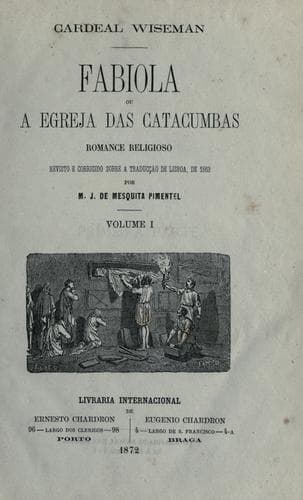
Fabiola; Or, The Church of the CatacombsWiseman, Nicholas Patrick
HistoryHistory
Fabiola; Or, The Church of the Catacombs
Wiseman, Nicholas Patrick
Christian fiction; Church history -- Primitive and early church, ca. 30-600 -- Fiction; Historical fiction
Diogenes rebuked him, saying, “That he comes to us in Pancratius’s
company is security enough.”
“I own,” interposed the youth, “that I do not know as much about him as
about Tiburtius, who is really a gallant, noble fellow. Torquatus is,
however, very anxious to obtain all information about our affairs, and
seems in earnest. What makes you fear, Severus?”
“Only a trifle, indeed. But as I was going early to the cemetery this
morning, I turned into the Baths of Antoninus.”[78]
“What!” interrupted Pancratius, laughing, “do you frequent such
fashionable resorts?”
“Not exactly,” replied the honest artist; “but you are not perhaps aware
that Cucumio the _capsarius_[79] and his wife are Christians?”
“Is it possible; where shall we find them next?”
“Well, so it is; and moreover they are making a tomb for themselves in
the cemetery of Callistus; and I had to show them Majus’s inscription
for it.”
“Here it is,” said the latter, exhibiting it, as follows:
CVCVMIO ET VICTORIA
SE VIVOS FECERVNT
CAPSARARIVS DE ANTONINIANAS.[80]
“Capital!” exclaimed Pancratius, amused at the blunders in the epitaph;
“but we are forgetting Torquatus.”
“As I entered the building, then,” said Severus, “I was not a little
surprised to find in one corner, at that early hour, this Torquatus in
close conversation with the present prefect’s son, Corvinus, the
pretended cripple, who thrust himself into Agnes’s house, you remember,
when some charitable unknown person (God bless him!) gave large alms to
the poor there. Not good company I thought, and at such an hour, for a
Christian.”
“True, Severus,” returned Pancratius, blushing deeply; “but he is young
as yet in the faith, and probably his old friends do not know of his
change. We will hope for the best.”
The two young men offered to accompany Pancratius, who rose to leave,
and see him safe through the poor and profligate neighborhood. He
accepted their courtesy with pleasure, and bade the old excavator a
hearty good night.
[Illustration: Our Saviour blessing the Bread, from a picture in the
Catacombs.]
CHAPTER II.
THE CEMETERIES.
+=========================+ || M. ANTONI || || VS. RESTVTV || || S.
FECIT. YPO || || CEVSIBI. ET || || SVIS. FIDENTI || || BVS. IN.
DOMINO.][81]|| +=========================+
It seems to us as though we had neglected one, whose character and
thoughts opened this little history, the pious Lucina. Her virtues were
indeed of that quiet, unobtrusive nature, which affords little scope for
appearing on a public scene, or taking part in general affairs. Her
house, besides being, or rather containing, a title or parochial church,
was now honored by being the residence of the supreme Pontiff. The
approach of a violent persecution, in which the rulers of Christ’s
spiritual kingdom were sure to be the first sought out, as the enemies
of Cæsar,
[Illustration: A Staircase in the Catacombs.]
Public-domain text, read in full here on John Shaqi.
Reviews
Reviews
No reviews yet
Be the first to share your thoughts on this work.
Elsewhere in the archive
Join the Discussion
Join the discussion
Sign in to leave a comment or review.
Sign InorCreate an account