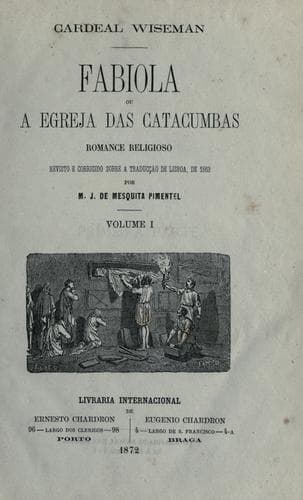
Fabiola; Or, The Church of the CatacombsWiseman, Nicholas Patrick
HistoryHistory
Fabiola; Or, The Church of the Catacombs
Wiseman, Nicholas Patrick
Christian fiction; Church history -- Primitive and early church, ca. 30-600 -- Fiction; Historical fiction
But ample proof is to be found in the catacombs themselves, of their
early origin. The style of paintings, yet remaining, belongs to a period
of still flourishing art. Their symbols, and the symbolical taste
itself, are characteristic of a very ancient period. For this peculiar
taste declined, as time went on. Although inscriptions with dates are
rare, yet out of ten thousand collected, and about to be published, by
the learned and sagacious Cavalier De Rossi, about three hundred are
found bearing consular dates, through every period, from the early
emperors to the middle of the fourth
[Illustration: A COLUMBARIUM,
Or underground sepulchre in which the Romans deposited the urns
containing the ashes of the dead.]
century (A.D. 350). Another curious and interesting custom furnishes us
with dates on tombs. At the closing of the grave, the relations or
friends, to mark it, would press into its wet plaster, and leave there a
coin, a cameo, or engraved gem, sometimes even a shell or pebble;
probably that they might find the sepulchre again, especially where no
inscription was left. Many of these objects continue to be found, many
have been long collected. But it is not uncommon, where the coin, or, to
speak scientifically, the medal, has fallen from its place, to find a
mould of it left, distinct and clear in the cement, which equally gives
its date. This is sometimes of Domitian, or other early emperors.
[Illustration: A _loculus_, open.]
It may be asked, wherefore this anxiety to rediscover with certainty the
tomb? Besides motives of natural piety, there is one constantly recorded
on sepulchral inscriptions. In England, if want of space prevented the
full date of a person’s death being given, we should prefer chronicling
the year, to the day of the month, when it occurred. It is more
historical. No one cares about remembering the day on which a person
died, without the year; but the year without the day, is an important
recollection. Yet while so few ancient Christian inscriptions supply the
year of people’s deaths, thousands give us the very day of it, on which
they died, whether in the hopefulness of believers, or in the assurance
of martyrs. This is easily explained. Of both classes annual
commemoration had to be made, on the very day of their departure; and
accurate knowledge of this was necessary. Therefore it alone was
recorded.
In a cemetery close to the one in which we have left our three youths,
with Diogenes and his sons,[89] were lately found inscriptions mingled
together, belonging to both orders of the dead. One in Greek, after
mentioning the “Deposition of Augenda on the 13th day before the
Calends, or 1st of June,” adds this simple address:
ΖΗCΑΙC ENKῶ KAI
EPωTA ΥΠΕΡΗΜωΝ
“Live in the Lord, and pray for us.”
Another fragment is as follows:
.....N. IVN-
......IVIBAS-
IN PACE ET PETE
PRO NOBIS
“Nones of June ... Live in peace, and pray for us.”
This is a third:
Public-domain text, read in full here on John Shaqi.
Reviews
Reviews
No reviews yet
Be the first to share your thoughts on this work.
Elsewhere in the archive
Join the Discussion
Join the discussion
Sign in to leave a comment or review.
Sign InorCreate an account