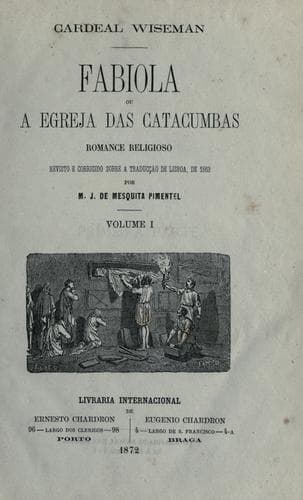
Fabiola; Or, The Church of the CatacombsWiseman, Nicholas Patrick
HistoryHistory
Fabiola; Or, The Church of the Catacombs
Wiseman, Nicholas Patrick
Christian fiction; Church history -- Primitive and early church, ca. 30-600 -- Fiction; Historical fiction
VICTORIA. REFRIGERER [ET]
ISSPIRITVS. TVS IN BONO
“Victoria, be refreshed, and may thy spirit be in enjoyment” (good).
]
This last reminds us of a most peculiar inscription found scratched in
the mortar beside a grave in the cemetery of Prætextatus, not many yards
from that of Callistus. It is remarkable, first, for being in Latin
written with Greek letters; then, for containing a testimony of the
Divinity of our Lord; lastly, for expressing a prayer for the
refreshment of the departed. We fill up the portions of words wanting,
from the falling out of part of the plaster.
[Illustration: “To the well-deserving sister Bon ... The eighth day
before the calends of Nov. Christ God Almighty refresh thy spirit in
Christ.”]
In spite of this digression on prayers inscribed over tombs, the reader
will not, we trust, have forgotten, that we were establishing the fact,
that the Christian cemeteries of Rome owe their origin to the earliest
ages. We have now to state down to what period they were used. After
peace was restored to the Church, the devotion of Christians prompted
them to desire burial near the martyrs, and holy people of an earlier
age. But, generally speaking, they were satisfied to lie under the
pavement. Hence the sepulchral stones which are often found in the
rubbish of the catacombs, and sometimes in their places, bearing
consular dates of the fourth century, are thicker, larger, better
carved, and in a less simple style, than those of an earlier period,
placed upon the walls. But before the end of that century, these
monuments become rarer; and interment in the catacombs ceased in the
following, at latest. Pope Damasus, who died in 384, reverently shrunk,
as he tells us, in his own epitaph, from intruding into the company of
the saints.
[Illustration: A Lamb with a Milk Pail, emblematic of the Blessed
Eucharist, found in the Catacombs.]
Restitutus, therefore, whose sepulchral tablet we gave for a title to
our chapter, may well be considered as speaking in the name of the early
Christians, and claiming as their own exclusive work and property, the
thousand miles of subterranean city, with their six millions of
slumbering inhabitants, who trust in the Lord, and await His
resurrection.[90]
CHAPTER III.
WHAT DIOGENES COULD NOT TELL ABOUT THE CATACOMBS.
Diogenes lived during the first period in the history of the cemeteries,
though near its close. Could he have looked into their future fate, he
would have seen, near at hand, an epoch that would have gladdened his
heart, to be followed by one that would have deeply afflicted him.
Although, therefore, the matter of this chapter have no direct bearing
upon our narrative, it will serve essentially to connect it with the
present topography of its scene.
Public-domain text, read in full here on John Shaqi.
Reviews
Reviews
No reviews yet
Be the first to share your thoughts on this work.
Elsewhere in the archive
Join the Discussion
Join the discussion
Sign in to leave a comment or review.
Sign InorCreate an account