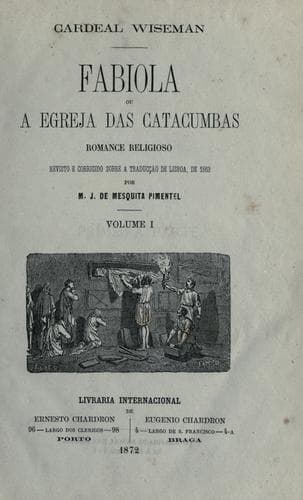
Fabiola; Or, The Church of the CatacombsWiseman, Nicholas Patrick
HistoryHistory
Fabiola; Or, The Church of the Catacombs
Wiseman, Nicholas Patrick
Christian fiction; Church history -- Primitive and early church, ca. 30-600 -- Fiction; Historical fiction
He struck up a different strain, and his learning quite astonished his
fellow-sophists. He had read the original books, he said, not only of
the Christians themselves, but of their forefathers, the Jews; who,
having come into Egypt in the reign of Ptolemy Philadelphus, to escape
from a famine in their own country, through the arts of their leader,
Josephus, bought up all the corn there, and sent it home. Upon which
Ptolemy imprisoned them, telling them, that as they had eaten up all the
corn, they should live on the straw, by making bricks with it for
building a great city. Then Demetrius Phalerius, hearing from them of a
great many curious histories of their ancestors, shut up Moses and
Aaron, their most learned men, in a tower, having shaved half their
beards, till they should write in Greek all their records. These rare
books Calpurnius had seen, and he would build his argument entirely on
them. This race made war upon every king and people, that came in their
way; and destroyed them all. It was their principle, if they took a
city, to put every one to the sword; and this was all because they were
under the government of their ambitious priests; so that when a certain
king, Saul, called also Paul, spared a poor captive monarch whose name
was Agag, the priests ordered him to be brought out and hewed in pieces.
“Now,” continued he, “these Christians are still under the domination of
the same priesthood, and are quite as ready to-day, under their
direction, to overthrow the great Roman empire, burn us all in the
Forum, and even sacrilegiously assail the sacred and venerable heads of
our divine emperors.”
A thrill of horror ran through the assembly, at this recital. It was
soon hushed, as the emperor opened his mouth to speak.
“For my part,” he said, “I have another and a stronger reason for my
abhorrence of these Christians. They have dared to establish in the
heart of the empire, and in this very city, a supreme religious
authority, unknown here before, independent of the government of the
State, and equally powerful over their minds as this. Formerly, all
acknowledged the emperor as supreme in religious, as in civil, rule.
Hence he bears still the title of Pontifex Maximus. But these men have
raised up a divided power, and consequently bear but a divided loyalty.
I hate, therefore, as a usurpation in my dominions, this sacerdotal sway
over my subjects. For I declare, that I would rather hear of a new rival
starting up to my throne, than of the election of one of these priests
in Rome.”[112]
This speech, delivered in a harsh grating voice, and with a vulgar
foreign accent, was received with immense applause; and plans were
formed for the simultaneous publication of the Edict through the West,
and for its complete and exterminating execution.
Then turning sharp upon Tertullus, the emperor said: “Prefect, you said
you had some one to propose, for superintending these arrangements, and
for merciless dealings with these traitors.”
Public-domain text, read in full here on John Shaqi.
Reviews
Reviews
No reviews yet
Be the first to share your thoughts on this work.
Elsewhere in the archive
Join the Discussion
Join the discussion
Sign in to leave a comment or review.
Sign InorCreate an account