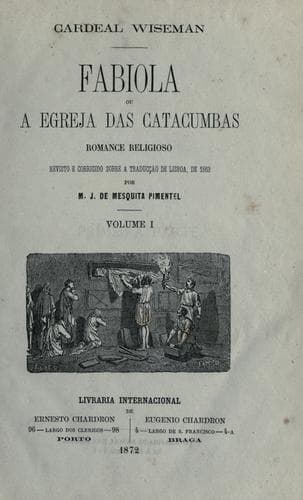
Fabiola; Or, The Church of the CatacombsWiseman, Nicholas Patrick
HistoryHistory
Fabiola; Or, The Church of the Catacombs
Wiseman, Nicholas Patrick
Christian fiction; Church history -- Primitive and early church, ca. 30-600 -- Fiction; Historical fiction
“He is here, sire, my son Corvinus.” And Tertullus handed the youthful
candidate to the grim tyrant’s footstool, where he knelt. Maximian eyed
him keenly, burst into a hideous laugh, and said: “Upon my word, I think
he’ll do. Why, prefect, I had no idea you had such an ugly son. I should
think he is just the thing; every quality of a thoroughpaced,
unconscientious scape-grace is stamped upon his features.”
Then turning to Corvinus, who was scarlet with rage, terror, and shame,
he said to him: “Mind you, sirrah, I must have clean work of it; no
hacking and hewing, no blundering. I pay up well if I am well served;
but I pay off well, too, if badly served. So now go; and remember, that
if your back can answer for a small fault, your head will for a greater.
The lictors’ _fasces_ contain an axe as well as rods.”
The emperor rose to depart, when his eye caught Fulvius, who had been
summoned as a paid court-spy, but who kept as much in the back-ground as
possible. “Ho, there, my eastern worthy,” he called out to him; “draw
nearer.”
Fulvius obeyed with apparent cheerfulness, but with real reluctance;
much the same as if he had been invited to go very near a tiger, the
strength of whose chain he was not quite sure about. He had seen, from
the beginning, that his coming to Rome had not been acceptable to
Maximian, though he knew not fully the cause. It was not merely that the
tyrant had plenty of favorites of his own to enrich, and spies to pay,
without Dioclesian’s sending him more from Asia, though this had its
weight; but it was more. He believed in his heart that Fulvius had been
sent principally to act the spy upon himself, and to report to Nicomedia
the sayings and doings of his court. While, therefore, he was obliged to
tolerate him, and employ him, he mistrusted and disliked him, which in
him was equivalent to hating him. It was some compensation, therefore,
to Corvinus, when he heard his more polished confederate publicly
addressed, as rudely as himself, in the following terms:
“None of your smooth, put-on looks for me, fellow. I want deeds, not
smirks. You came here as a famous plothunter, a sort of stoat, to pull
conspirators out of their nests, or suck their eggs for me. I have seen
nothing of this so far; and yet you have had plenty of money to set you
up in business. These Christians will afford you plenty of game; so make
yourself ready, and let us see what you can do. You know my ways; you
had better look sharp about you, therefore, or you may have to look at
something very sharp before you. The property of the convicted will be
divided between the accusers and the treasury; unless I see particular
reasons for taking the whole to myself. Now you may go.”
[Illustration: Monogram of Christ, found in the Catacombs.]
Most thought that these particular reasons would turn out to be very
general.
CHAPTER VII.
DARK DEATH.
Public-domain text, read in full here on John Shaqi.
Reviews
Reviews
No reviews yet
Be the first to share your thoughts on this work.
Elsewhere in the archive
Join the Discussion
Join the discussion
Sign in to leave a comment or review.
Sign InorCreate an account