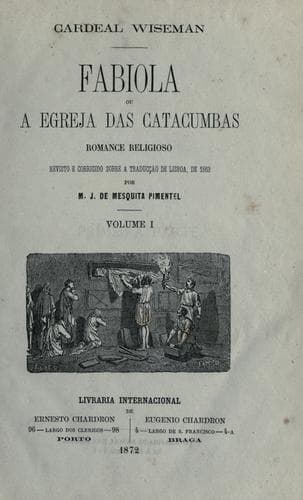
Fabiola; Or, The Church of the CatacombsWiseman, Nicholas Patrick
HistoryHistory
Fabiola; Or, The Church of the Catacombs
Wiseman, Nicholas Patrick
Christian fiction; Church history -- Primitive and early church, ca. 30-600 -- Fiction; Historical fiction
The letter of which Torquatus was the bearer to him, had produced its
desired effect. He called at his villa, and spent a few days with his
daughter, on his way to Asia. He was more than usually affectionate; and
when they parted, both father and daughter seemed to have a melancholy
foreboding that they would meet no more. He soon, however, recovered his
spirits at Baiæ, where a party of good livers anxiously awaited him; and
where he considered himself obliged to stay, while his galley was being
fitted up and stored with the best wines and provisions which Campania
afforded, for his voyage. He indulged, however, his luxurious tastes to
excess; and on coming out of a bath, after a hearty supper, he was
seized with a chill, and in four-and-twenty hours was a corpse. He had
left his undivided wealth to his only child. In fine, the body was being
embalmed when the courier started, and was to be brought by his galley
to Ostia.
On hearing this sad tale, Sebastian was almost sorry that he had spoken
as he had done of death, and left the house with mournful thoughts.
Fabiola’s first plunge into the dark abyss of grief was deep and dismal,
down into unconsciousness. Then the buoyancy of youth and mind bore her
up again to the surface; and her view of life, to the horizon, was as of
a boundless ocean of black seething waves, on which floated no living
thing save herself. Her woe seemed utter and unmeasured; and she closed
her eyes with a shudder, and suffered herself to sink again into
obliviousness, till once more roused to wakefulness of mind. Again and
again she was thus tossed up and down, between transient death and life,
while her attendants applied remedies to what they deemed a succession
of alarming fits and convulsions. At length she sat up, pale, staring,
and tearless, gently pushing aside the hand that tried to administer
restoratives to her. In this state she remained long; a stupor, fixed
and deadly, seemed to have entranced her; the pupils were almost
insensible to the light, and fears were whispered of her brain becoming
oppressed. The physician, who had been called, uttered distinctly and
forcibly into her ears the question: “Fabiola, do you know that your
father is dead?” She started, fell back, and a bursting flood of tears
relieved her heart and head. She spoke of her father, and called for him
amidst her sobs, and said wild and incoherent, but affectionate things
about, and to, him. Sometimes she seemed to think him still alive, then
she remembered he was dead; and so she wept and moaned, till sleep took
the turn of tears, in nursing her shattered mind and frame.
Public-domain text, read in full here on John Shaqi.
Reviews
Reviews
No reviews yet
Be the first to share your thoughts on this work.
Elsewhere in the archive
Join the Discussion
Join the discussion
Sign in to leave a comment or review.
Sign InorCreate an account