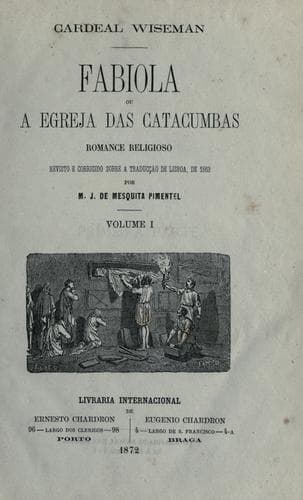
Fabiola; Or, The Church of the CatacombsWiseman, Nicholas Patrick
HistoryHistory
Fabiola; Or, The Church of the Catacombs
Wiseman, Nicholas Patrick
Christian fiction; Church history -- Primitive and early church, ca. 30-600 -- Fiction; Historical fiction
“No, no, gentle lady,” exclaimed Sebastian, emphatically. “I mean not
so. I care not for glory, which can only be enjoyed by an anticipating
fancy. I speak of vulgar death, as it may come to me in common with the
poorest slave; consuming me by slow burning fever, wasting me by long
lingering consumption, racking me by slowly eating ulcers; nay, if you
please, by the still crueller inflictions of men’s wrath. In any form
let it come; it comes from a hand that I love.”
“And do you really mean that death, so contemplated, would be welcomed
by you?”
“As joyful as is the epicure, when the doors of the banqueting-hall are
thrown wide open, and he sees beyond them the brilliant lamps, the
glittering table, and its delicious viands, with its attendant ministers
well girt, and crowned with roses; as blithe as is the bride when the
bridegroom is announced, coming with rich gifts, to conduct her to her
new home, will my exulting heart be, when death, under whatever form,
throws back the gates, iron on this side, but golden on the other, which
lead to a new and perennial life. And I care not how grim the messenger
may be, that proclaims the approach of Him who is celestially
beautiful.”
“And who is He?” asked Fabiola, eagerly. “Can He not be seen, save
through the fleshless ribs of death?”
“No,” replied Sebastian; “for it is He who must reward us, not only for
our lives, but for our deaths also. Happy they whose inmost hearts,
which He has ever read, have been kept pure and innocent, as well as
their deeds have been virtuous! For them is this bright vision of Him,
whose true rewards only then begin.”
How very like Syra’s doctrines! she thought. But before she could speak
again, to ask whence they came, a slave entered, stood on the threshold,
and respectfully said:
“A courier, madam, is just arrived from Baiæ.”[114]
“Pardon me, Sebastian!” she exclaimed. “Let him enter immediately.”
The messenger came in, covered with dust and jaded, having left his
tired horse at the gate; and offered her a sealed packet.
Her hand trembled as she took it; and while she was unloosening its
bands, she hesitatingly asked:
“From my father?”
“About him, at least,” was the ominous reply.
She opened the sheet, glanced over it, shrieked, and fell. Sebastian
caught her before she reached the ground, laid her on a couch, and
delicately left her in the hands of her handmaids, who had rushed in at
the cry.
[Illustration: Monogram of Christ, found in the Catacombs.]
One glance had told her all. Her father was dead.
CHAPTER VIII.
DARKER STILL.
When Sebastian came into the court, he found a little crowd of domestics
gathered round the courier, listening to the details of their master’s
death.
Public-domain text, read in full here on John Shaqi.
Reviews
Reviews
No reviews yet
Be the first to share your thoughts on this work.
Elsewhere in the archive
Join the Discussion
Join the discussion
Sign in to leave a comment or review.
Sign InorCreate an account