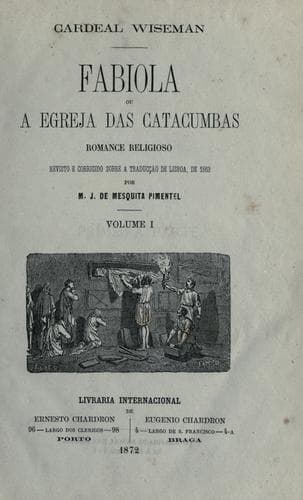
Fabiola; Or, The Church of the CatacombsWiseman, Nicholas Patrick
HistoryHistory
Fabiola; Or, The Church of the Catacombs
Wiseman, Nicholas Patrick
Christian fiction; Church history -- Primitive and early church, ca. 30-600 -- Fiction; Historical fiction
While these thoughts dwell like gloomy night on the heart of Fabiola,
her slave is enjoying the vision of light, clothed in mortal form,
translucid and radiant, rising from the grave as from an alembic, in
which have remained the grosser qualities of matter, without impairing
the essence of its nature. Spiritualized and free, lovely and glorious,
it springs from the very hot-bed of corruption. And another and another,
from land and sea; from reeking cemetery, and from beneath consecrated
altar; from the tangled thicket where solitary murder has been
committed on the just, and from fields of ancient battle done by Israel
for God; like crystal fountains springing into the air, like brilliant
signal-lights, darted from earth to heaven, till a host of millions,
side by side, repeoples creation with joyous and undying life. And how
knows she this? Because One, greater and better than poet, sage, or
sophist, had made the trial; had descended first into the dark couch of
death, had blessed it, as He had done the cradle, and made infancy
sacred; rendering also death a holy thing, and its place a sanctuary. He
went into it in the darkest of evening, and He came forth from it in the
brightest of morning; He was laid there wrapped in spices, and he rose
again robed in His own fragrant incorruption. And from that day the
grave had ceased to be an object of dread to the Christian soul, for it
continued what he had made it,--the furrow into which the seed of
immortality must needs be cast.
The time was not come for speaking of these things to Fabiola. She
mourned still, as they must mourn who have no hope. Day succeeded day in
gloomy meditation on the mystery of death, till other cares mercifully
roused her. The corpse arrived, and such a funeral followed as Rome then
seldom witnessed. Processions by torch-light, in which the waxen
effigies of ancestors were borne, and a huge funeral pile, built up of
aromatic wood, and scented by the richest spices of Arabia, ended in her
gathering up a few handfuls of charred bones, which were deposited in an
alabaster urn, and placed in a niche of the family sepulchre, with the
name inscribed of their former owner.
Public-domain text, read in full here on John Shaqi.
Reviews
Reviews
No reviews yet
Be the first to share your thoughts on this work.
Elsewhere in the archive
Join the Discussion
Join the discussion
Sign in to leave a comment or review.
Sign InorCreate an account