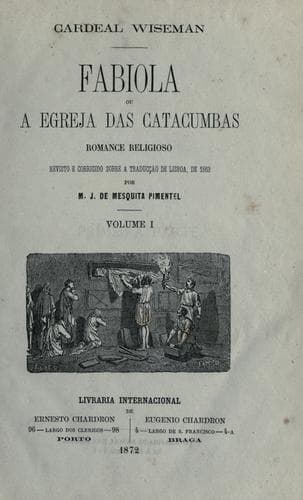
Fabiola; Or, The Church of the CatacombsWiseman, Nicholas Patrick
HistoryHistory
Fabiola; Or, The Church of the Catacombs
Wiseman, Nicholas Patrick
Christian fiction; Church history -- Primitive and early church, ca. 30-600 -- Fiction; Historical fiction
Calpurnius spoke the funeral oration; in which, according to the
fashionable ideas of the day, he contrasted the virtues of the
hospitable and industrious citizen with the false morality of those men
called Christians, who fasted and prayed all day, and were stealthily
insinuating their dangerous principles into every noble family, and
spreading disloyalty and immorality in every class. Fabius, he could
have no doubt, if there was any future existence, whereon philosophers
differed, was now basking on a green bank in Elysium, and quaffing
nectar. “And oh!” concluded the old whining hypocrite, who would have
been sorry to exchange one goblet of Falernian for an amphora[115] of
that beverage, “oh! that the gods would hasten the day when I, his
humble client, may join him in his shady repose and sober banquets!”
This noble sentiment gained immense applause.
To this care succeeded another. Fabiola had to apply her vigorous mind
to examine, and close her father’s complicated affairs. How often was
she pained at the discovery of what to her seemed injustice, fraud,
over-reaching and oppression, in the transactions of one whom the world
had applauded as the most honest and liberal of public contractors!
[Illustration: The Peacock, as an Emblem of the Resurrection, found in
the Catacombs.]
In a few weeks more, in the dark attire of a mourner, Fabiola went forth
to visit her friends. The first of these was her cousin Agnes.
CHAPTER IX.
THE FALSE BROTHER.
We must take our reader back a few steps in the history of Torquatus. On
the morning after his fall, he found, on awaking, Fulvius at his
bed-side. It was the falconer, who, having got hold of a good hawk, was
come to tame him, and train him to strike down the dove for him, in
return for a well-fed slavery. With all the coolness of a practised
hand, he brought back to his memory every circumstance of the preceding
night’s debauch, his utter ruin, and only means of escape. With
unfeeling precision he strengthened every thread of the last evening’s
web, and added many more meshes to it.
The position of Torquatus was this: if he made one step towards
Christianity, which Fulvius assured him would be fruitless, he would be
at once delivered to the judge, and cruelly punished with death. If he
remained faithful to his compact of treason, he should want for nothing.
“You are hot and feverish,” at last concluded Fulvius; “an early walk,
and fresh air, will do you good.”
The poor wretch consented; and they had hardly reached the Forum, when
Corvinus, as if by accident, met them. After mutual salutations, he
said: “I am glad to have fallen in with you; I should like to take you,
and show you my father’s workshop.”
“Workshop?” asked Torquatus with surprise.
“Yes, where he keeps his tools; it has just been beautifully fitted up.
Here it is, and that grim old foreman, Catulus, is opening the doors.”
Public-domain text, read in full here on John Shaqi.
Reviews
Reviews
No reviews yet
Be the first to share your thoughts on this work.
Elsewhere in the archive
Join the Discussion
Join the discussion
Sign in to leave a comment or review.
Sign InorCreate an account