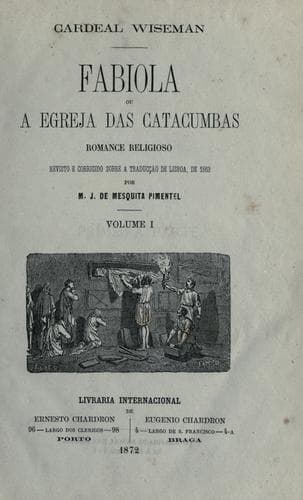
Fabiola; Or, The Church of the CatacombsWiseman, Nicholas Patrick
HistoryHistory
Fabiola; Or, The Church of the Catacombs
Wiseman, Nicholas Patrick
Christian fiction; Church history -- Primitive and early church, ca. 30-600 -- Fiction; Historical fiction
Their meetings were early and late; during the day he was left free,
lest he should lose his value, through being suspected by Christians.
Corvinus had determined to make a tremendous dash at them, so soon as
the Edict should have come out. He therefore exacted from Torquatus, as
his share of the compact, that the spy should study the principal
cemetery where the pontiff intended to officiate. This Torquatus soon
ascertained; and his visit to the cemetery of Callistus was in
fulfilment of his engagement. When that struggle between grace and sin
took place in his soul, which Severus noticed, it was the image of
Catulus and his hundred plagues, with that of Fulvius and his hundred
bonds, that turned the scale in favor of perdition. Corvinus, after
receiving his report, and making from it a rough chart of the cemetery,
determined to assail it, early, the very day after the publication of
the Decree.
Fulvius took another course. He determined to become acquainted, by
sight, with the principal clergy, and leading Christians, of Rome. Once
possessed of this knowledge, he was sure no disguise would conceal them
from his piercing eyes; and he would easily pick them up, one by one. He
therefore insisted upon Torquatus’s taking him as his companion, to the
first great function that should collect many priests and deacons round
the Pope. He overruled
[Illustration: Christ and His Apostles, from a picture in the
Catacombs.]
every remonstrance, dispelled every fear; and assured Torquatus, that
once in, by his password, he should behave perfectly like any Christian.
Torquatus soon informed him, that there would be an excellent
opportunity at the coming ordination, in that very month of December.
CHAPTER X.
THE ORDINATION IN DECEMBER.
Whoever has read the history of the early Popes, will have become
familiar with the fact, recorded almost invariably of each, that he held
certain ordinations in the month of December, wherein he created so many
priests, and deacons, and so many bishops for different places. The
first two orders were conferred to supply clergy for the city; the third
was evidently to furnish pastors for other dioceses. In later times, the
ember-days in December, regulated by the festival of St. Lucy, were
those on which the Supreme Pontiff held his consistories, in which he
named his cardinal priests and deacons, and preconized, as it is called,
the bishops of all parts of the world. And, though this function is not
now coincident with the periods of ordination, still it is continued
essentially for the same purpose.
Marcellinus, under whose pontificate our narrative is placed, is stated
to have held two ordinations in this month, that is, of course, in
different years. It was to one of these that we have alluded, as about
to take place.
Public-domain text, read in full here on John Shaqi.
Reviews
Reviews
No reviews yet
Be the first to share your thoughts on this work.
Elsewhere in the archive
Join the Discussion
Join the discussion
Sign in to leave a comment or review.
Sign InorCreate an account