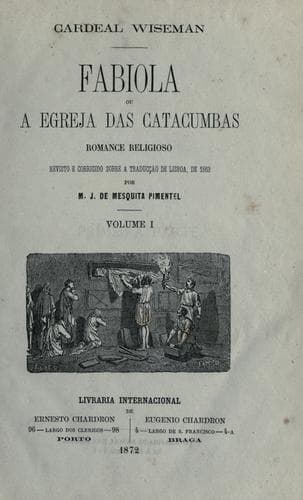
Fabiola; Or, The Church of the CatacombsWiseman, Nicholas Patrick
HistoryHistory
Fabiola; Or, The Church of the Catacombs
Wiseman, Nicholas Patrick
Christian fiction; Church history -- Primitive and early church, ca. 30-600 -- Fiction; Historical fiction
Where was this solemn function to be performed was Fulvius’s first
inquiry. And we cannot but think that the answer will be interesting to
the Christian antiquary. Nor can our acquaintance with the ancient Roman
Church be complete, without our knowing the favored spot where Pontiff
after Pontiff preached, and celebrated the divine mysteries, and held
his councils, or those glorious ordinations, which sent forth not only
bishops but martyrs to govern other churches, and gave to a St. Laurence
his diaconate, or to St. Novatus or St. Timotheus his priesthood. There,
too, a Polycarp or Irenæus visited the successor of St. Peter; and
thence received their commission the apostles who converted our King
Lucius to the faith.
The house which the Roman Pontiffs inhabited, and the church in which
they officiated till Constantine installed them in the Lateran palace
and basilica, the residence and cathedral of the illustrious line of
martyr-popes for 300 years, can be no ignoble spot. And that, in tracing
it out, we may not be misguided by national or personal prepossession,
we will follow a learned living antiquarian, who, intent upon another
research, accidentally has put together all the data requisite for our
purpose.[117]
We have described the house of Agnes’s parents as situated in the _Vicus
Patricius_, or the Patrician-street. This had another name, for it was
also called the street of the Cornelii, _Vicus Corneliorum_, because in
it lived the illustrious family of that name. The centurion whom St.
Peter converted[118] belonged to this family; and possibly to him the
apostle owed his introduction at Rome to the head of his house,
Cornelius Pudens. This senator married Claudia, a noble British lady;
and it is singular how the unchaste poet Martial vies with the purest
writers when he sings the wedding-song of these two virtuous spouses.
It was in their house that St. Peter lived; and his fellow-apostle St.
Paul enumerates them among his familiar friends, as well: “Eubulus and
Pudens, and Linus and Claudia,
[Illustration: St. Pudentiana, St. Priscilla, and St. Praxedes.]
and all the brethren salute thee.”[119] From that house, then, went
forth the bishops, whom the Prince of the Apostles sent in every
direction, to propagate, and die for, the faith of Christ. After the
death of Pudens, the house became the property of his children, or
grandchildren,[120] two sons and two daughters. The latter are better
known, because they have found a place in the general calendar of the
Church, and because they have given their names to two of the most
illustrious churches of Rome, those of St. Praxedes and St. Pudentiana.
It is the latter, which Alban Butler calls “the most ancient church in
the world,”[121] that marks at once the Vicus Patricius, and the house
of Pudens.
Public-domain text, read in full here on John Shaqi.
Reviews
Reviews
No reviews yet
Be the first to share your thoughts on this work.
Elsewhere in the archive
Join the Discussion
Join the discussion
Sign in to leave a comment or review.
Sign InorCreate an account