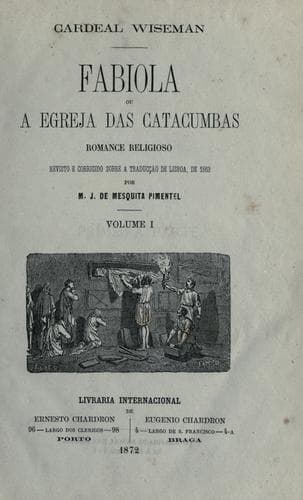
Fabiola; Or, The Church of the CatacombsWiseman, Nicholas Patrick
HistoryHistory
Fabiola; Or, The Church of the Catacombs
Wiseman, Nicholas Patrick
Christian fiction; Church history -- Primitive and early church, ca. 30-600 -- Fiction; Historical fiction
The bishop then addressed the young aspirants, in glowing and
affectionate words. He told them how high a call it was to lead on earth
the lives of angels, who neither marry nor give in marriage, to tread
the same chaste path to heaven which the Incarnate Word chose for His
own Mother; and arrived there, to be received into the pure ranks of
that picked host, that follows the Lamb whithersoever He goeth. He
expatiated on the doctrine of St. Paul, writing to the Corinthians on
the superiority of virginity to every other state; and he feelingly
described the happiness of having no love on earth but one, which
instead of fading, opens out into immortality, in heaven. For bliss, he
observed, is but the expanded flower which Divine love bears on earth.
After this brief discourse, and an examination of the candidates for
this great honor, the holy Pontiff proceeded to bless the different
portions of their religious habits, by prayers probably nearly identical
with those now in use; and these were put on them by their respective
attendants. The new religious laid their heads upon the altar, in token
of their oblation of self. But in the West, the hair was not cut, as it
was in the East, but was always left long. A wreath of flowers was then
placed upon the head of each; and though it was winter, the well-guarded
terrace of Fabiola had been made to furnish bright and fragrant
blossoms.
All seemed ended; and Agnes, kneeling at the foot of the altar, was
motionless in one of her radiant raptures, gazing fixedly upwards; while
Syra, near her, was bowed down, sunk into the depths of her gentle
humility, wondering how she should have been found worthy of so much
favor. So absorbed were both in their thanksgiving, that they perceived
not a slight commotion through the assembly, as if something unexpected
was occurring.
They were aroused by the bishop repeating the question: “My daughter,
what dost thou seek?” when, before they could look round, each felt a
hand seized, and heard the answer returned in a voice dear to both:
“Holy father, to receive the veil of consecration to Jesus Christ, my
only love on earth, under the care of these two holy virgins, already
His happy spouses.”
They were overwhelmed with joy and tenderness; for it was the poor blind
Cæcilia. When she heard of the happiness that awaited Syra, she had
flown, as we have seen, to the kind Lucina, who soon consoled her, by
suggesting to her the possibility of obtaining a similar grace. She
promised to furnish all that was necessary; only Cæcilia insisted that
her dress should be coarse, as became a poor beggar-girl. The priest
Dionysius presented to the Pontiff, and obtained the grant of, her
prayer; and as she wished to have her two friends for sponsors, it was
arranged that he should lead her up to the altar after their
consecration. Cæcilia, however, kept her secret.
Public-domain text, read in full here on John Shaqi.
Reviews
Reviews
No reviews yet
Be the first to share your thoughts on this work.
Elsewhere in the archive
Join the Discussion
Join the discussion
Sign in to leave a comment or review.
Sign InorCreate an account