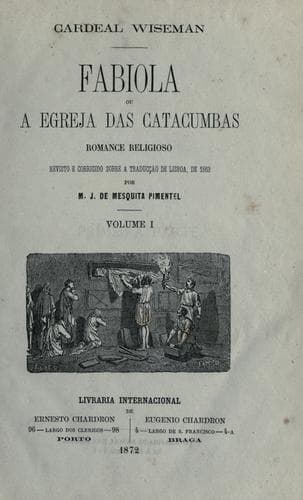
Fabiola; Or, The Church of the CatacombsWiseman, Nicholas Patrick
HistoryHistory
Fabiola; Or, The Church of the Catacombs
Wiseman, Nicholas Patrick
Christian fiction; Church history -- Primitive and early church, ca. 30-600 -- Fiction; Historical fiction
The happy morning at length arrived, and before daybreak the more solemn
mysteries had been celebrated, and the body of the faithful had
dispersed. Only those remained who had to take part in the more private
function, or who were specially asked to witness it. These were Lucina
and her son, the aged parents of Agnes, and of course Sebastian. But
Syra looked in vain for her blind friend; she had evidently retired
with the crowd; and the gentle slave feared she might have hurt her
feelings by her reserve, before their last interview.
The hall was still shrouded in the dusk of a winter’s twilight, although
the glowing east, without, foretold a bright December day. On the altar
burned perfumed tapers of large dimensions, and round it were gold and
silver lamps of great value, throwing an atmosphere of mild radiance
upon the sanctuary. In front of the altar was placed the chair no less
venerable than itself, now enshrined in the Vatican, the chair of Peter.
On this was seated the venerable Pontiff, with staff in hand, and crown
on head, and round him stood his ministers, scarcely less worshipful
than himself.
[Illustration: Chair of St. Peter.]
From the gloom of the chapel, there came forth first the sound of sweet
voices, like those of angels, chanting in soft cadence, a hymn, which
anticipated the sentiments soon after embodied in the
“Jesu corona virginum.”[135]
Then there emerged into the light of the sanctuary the procession of
already consecrated virgins, led by the priests and deacons who had
charge of them. And in the midst of them appeared two, whose dazzling
white garments shone the brighter amidst their dark habits. These were
the two new postulants, who, as the rest defiled and formed a line on
either side, were conducted, each by two professed, to the foot of the
altar, where they knelt at the Pontiff’s feet. Their bridesmaids, or
sponsors, stood near to assist in the function.
Each as she came was asked solemnly what she desired, and expressed her
wish to receive the veil, and practise its duties, under the care of
those chosen guides. For, although consecrated virgins had begun to live
in community before this period, yet many continued to reside at home;
and persecution interfered with enclosure. Still there was a place in
church, boarded off for the consecrated virgins; and they often met
apart, for particular instruction and devotions.
Public-domain text, read in full here on John Shaqi.
Reviews
Reviews
No reviews yet
Be the first to share your thoughts on this work.
Elsewhere in the archive
Join the Discussion
Join the discussion
Sign in to leave a comment or review.
Sign InorCreate an account