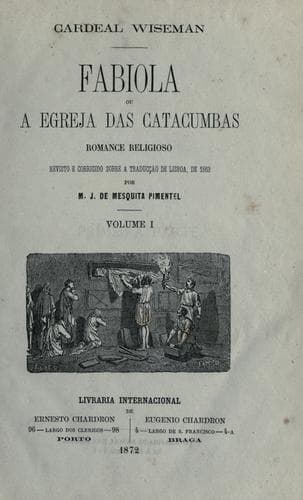
Fabiola; Or, The Church of the CatacombsWiseman, Nicholas Patrick
HistoryHistory
Fabiola; Or, The Church of the Catacombs
Wiseman, Nicholas Patrick
Christian fiction; Church history -- Primitive and early church, ca. 30-600 -- Fiction; Historical fiction
“I have come, Lady Agnes,” he said, “to renew to you the expression of
my sincere regard; and I could not have chosen a better day, for
brighter or fairer scarcely the summer sun could have bestowed.”
“Fair, indeed, and bright it has been to me,” replied Agnes, borne back
in mind to the morning’s scene; “and no sun in my life has ever given me
fairer,--it can only give me _one_ more fair.”
Fulvius was flattered, as if the compliment was to his presence, and
answered, “The day, no doubt you mean, of your espousals with one who
may have won your heart.”
“That is indeed done,” she replied, as if unconsciously; “and this is
his own precious day.”
“And was that wreathed veil upon your head, placed there in anticipation
of this happy hour?”
“Yes; it is the sign my beloved has placed upon my countenance, that I
recognize no lover but himself.”[136]
“And who is this happy being? I was not without hopes, nor will I
renounce them yet, that I have a place in your thoughts, perhaps in your
affections.”
Agnes seemed scarcely to heed his words. There was no appearance of
shyness or timidity in her looks or manner, no embarrassment even:
“Spotless without, and innocent within,
She feared no danger, for she knew no sin.”
Her childlike countenance remained bright, open, and guileless; her
eyes, mildly beaming, looked straight upon Fulvius’s face with an
earnest simplicity, that made him almost quail before her. She stood up
now, with graceful dignity, as she replied:
“Milk and honey exhaled from his lips, as the blood from his stricken
cheek impressed itself on mine.”[137]
She is crazed, Fulvius was just beginning to think; when the inspired
look of her countenance, and the clear brightness of her eye, as she
gazed forwards towards some object seen by herself alone, overawed and
subdued him. She recovered in an instant; and again he took heart. He
resolved at once to pursue his demand.
“Madam,” he said, “you are trifling with one who sincerely admires and
loves you. I know from the best authority,--yes, the _best_
authority,--that of a mutual friend departed, that you have been pleased
to think favorably of me, and to express yourself not opposed to my
urging my claims to your hand. I now, therefore, seriously and earnestly
solicit it. I may seem abrupt and informal, but I am sincere and warm.”
“Begone from me, food of corruption!” she said with calm majesty; “for
already a lover has secured my heart, for whom alone I keep my troth, to
whom I intrust myself with undivided devotion; one whose love is chaste,
whose caress is pure, whose brides never put off their virginal
wreaths.”[138]
Public-domain text, read in full here on John Shaqi.
Reviews
Reviews
No reviews yet
Be the first to share your thoughts on this work.
Elsewhere in the archive
Join the Discussion
Join the discussion
Sign in to leave a comment or review.
Sign InorCreate an account