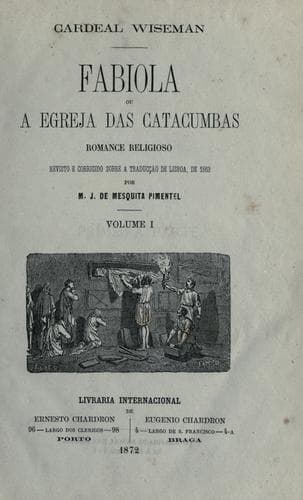
Fabiola; Or, The Church of the CatacombsWiseman, Nicholas Patrick
HistoryHistory
Fabiola; Or, The Church of the Catacombs
Wiseman, Nicholas Patrick
Christian fiction; Church history -- Primitive and early church, ca. 30-600 -- Fiction; Historical fiction
Fulvius, who had dropped on his knee as he concluded his last sentence,
and had thus drawn forth that severe rebuke, rose, filled with spite and
fury, at having been so completely deluded. “Is it not enough to be
rejected,” he said, “after having been encouraged, but must insult be
heaped on me too? and must I be told to my face that another has been
before me to-day?--Sebastian, I suppose, again----”
“Who are you?” exclaimed an indignant voice behind him, “that dare to
utter with disdain, the name of one whose honor is untarnished, and
whose virtue is as unchallenged as his courage?”
He turned round, and stood confronted with Fabiola, who, having walked
for some time about the garden, thought she would now probably find her
cousin disengaged, and by herself. She had come upon him suddenly, and
had caught his last words.
Fulvius was abashed, and remained silent.
Fabiola, with a noble indignation, continued. “And who, too, are you,
who, not content with having once thrust yourself into my kinswoman’s
house, to insult her, presume now to intrude upon the privacy of her
rural retreat?”
[Illustration: “Haughty Roman dame! thou shalt bitterly rue this day and
hour.”]
“And who are you,” retorted Fulvius, “who take upon yourself to be
imperious mistress in another’s house?”
“One,” replied the lady, “who, by allowing my cousin to meet you first
at her table, and there discovering your designs upon an innocent child,
feels herself bound in honor and duty to thwart them, and to shield her
from them.”
She took Agnes by the hand, and was leading her away; and Molossus
required what he never remembered to have received before, but what he
took delightedly, a gentle little tap, to keep him from more than
growling; when Fulvius, gnashing his teeth, muttered audibly:
“Haughty Roman dame! thou shalt bitterly rue this day and hour. Thou
shalt know and feel how Asia can revenge.”
[Illustration: A Lamb between Wolves, emblematic of the Church, from a
picture in the Cemetery of St. Prætextatus.]
CHAPTER XIII.
THE EDICT.
Public-domain text, read in full here on John Shaqi.
Reviews
Reviews
No reviews yet
Be the first to share your thoughts on this work.
Elsewhere in the archive
Join the Discussion
Join the discussion
Sign in to leave a comment or review.
Sign InorCreate an account