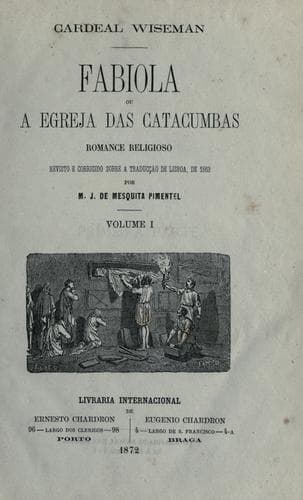
Fabiola; Or, The Church of the CatacombsWiseman, Nicholas Patrick
HistoryHistory
Fabiola; Or, The Church of the Catacombs
Wiseman, Nicholas Patrick
Christian fiction; Church history -- Primitive and early church, ca. 30-600 -- Fiction; Historical fiction
The day being at length arrived for its publication in Rome, Corvinus
fully felt the importance of the commission intrusted to him, of
affixing in its proper place in the Forum, the edict of extermination
against the Christians, or rather the sentence of extirpation of their
very name. News had been received from Nicodemia, that a brave Christian
soldier, named George, had torn down a similar imperial degree, and had
manfully suffered death for his boldness. Corvinus was determined that
nothing of the sort should happen in Rome; for he feared too seriously
the consequences of such an occurrence to himself; he therefore took
every precaution in his power. The edict had been written in large
characters, upon sheets of parchment joined together; and these were
nailed to a board, firmly supported by a pillar, against which it was
hung, not far from the Puteal Libonis, the magistrate’s chair in the
Forum. This, however, was not done till the Forum was deserted, and
night had well set in. It was thus intended that the edict should meet
the eyes of the citizens early in the morning, and strike their minds
with more tremendous effect.
To prevent the possibility of any nocturnal attempt to destroy the
precious document, Corvinus, with much the same cunning precaution as
was taken by the Jewish priests to prevent the Resurrection, obtained
for a night-guard to the Forum, a company of the Pannonian cohort, a
body composed of soldiers belonging to the fiercest races of the North,
Dacians, Pannonians, Sarmatians, and Germans, whose uncouth features,
savage aspect, matted sandy hair, and bushy red moustaches, made them
appear absolutely ferocious to Roman eyes. These men could scarcely
speak Latin, but were ruled by officers of their own countries, and
formed, in the decline of the empire, the most faithful body-guard of
the reigning tyrants, often their fellow-countrymen; for there was no
excess too monstrous for them to commit, if duly commanded to execute
it.
A number of these savages, ever rough and ready, were distributed so as
to guard every avenue of the Forum, with strict orders to pierce
through, or hew down, any one who should attempt to pass without the
watchword, or _symbolum_. This was every night distributed by the
general in command, through his tribunes and centurions, to all the
troops. But to prevent all possibility of any Christian making use of it
that night, if he should chance to discover it, the cunning Corvinus had
one chosen which he felt sure no Christian would use. It was NUMEN
IMPERATORUM: the “Divinity of the Emperors.”
Public-domain text, read in full here on John Shaqi.
Reviews
Reviews
No reviews yet
Be the first to share your thoughts on this work.
Elsewhere in the archive
Join the Discussion
Join the discussion
Sign in to leave a comment or review.
Sign InorCreate an account