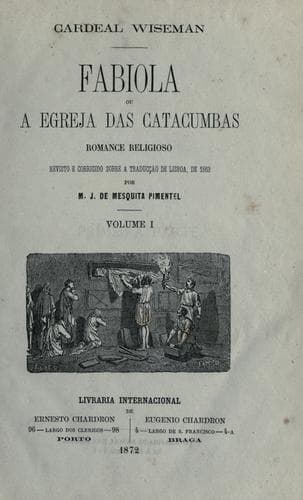
Fabiola; Or, The Church of the CatacombsWiseman, Nicholas Patrick
HistoryHistory
Fabiola; Or, The Church of the Catacombs
Wiseman, Nicholas Patrick
Christian fiction; Church history -- Primitive and early church, ca. 30-600 -- Fiction; Historical fiction
“You are right, my friend; I must make it out that a strong body
attacked you, and killed you at your post. So shut yourself up in
quarters for a few days, and you shall have plenty of beer, till the
thing blows over.”
The soldier went off, and concealed himself. A few days after, the dead
body of a Dacian, evidently murdered, was washed on the banks of the
Tiber. It was supposed he had fallen in some drunken row; and no further
trouble was taken about it. The fact was indeed so; but Corvinus could
have given the best account of the transaction. Before, however, leaving
the ill-omened spot in the Forum, he had carefully examined the ground,
for any trace of the daring act; when he picked up, close under the
place of the edict, a knife, which he was sure he had seen at school, in
possession of one of his companions. He treasured it up, as an implement
of future vengeance, and hastened to provide another copy of the decree.
[Illustration: An Emblem of Paradise, found in the Catacombs.]
CHAPTER XV.
EXPLANATIONS.
When morning had fairly broken, crowds streamed, from every side, into
the Forum, curious to read the tremendous edict so long menaced. But
when they found only a bare board, there was a universal uproar. Some
admired the spirit of the Christians, so generally reckoned cowardly;
others were indignant at the audacity of such an act; some ridiculed the
officials concerned in the proclamation; others were angry that the
expected sport of the day might be delayed.
At an early hour the places of public fashionable resort were all
occupied with the same theme. In the great Antonian Thermæ a group of
regular frequenters were talking it over. There were Scaurus the lawyer,
and Proculus, and Fulvius, and the philosopher Calpurnius, who seemed
very busy with some musty volumes, and several others.
“What a strange affair this is, about the edict!” said one.
“Say rather, what a treasonable outrage against the divine emperors!”
answered Fulvius.
“How was it done?” asked a third.
“Have you not heard,” said Proculus, “that the Dacian guard stationed at
the Puteal was found dead, with twenty-seven poniard-wounds on him,
nineteen of which would have sufficed each by itself to cause death?”
“No, that is quite a false report,” interrupted Scaurus; “it was not
done by violence, but entirely by witchcraft. Two women came up to the
soldier, who drove his lance at one, and it passed clean through her,
and stuck in the ground on the other side, without making any wound in
her. He then hacked at the other with his sword, but he might as well
have struck at marble. She then threw a pinch of powder upon him, and he
flew into the air, and was found, asleep and unhurt, this morning, on
the roof of the Æmilian basilica. A friend of mine, who was out early,
saw the ladder up, by which he had been brought down.”
“Wonderful!” many exclaimed. “What extraordinary people these Christians
must be!”
Public-domain text, read in full here on John Shaqi.
Reviews
Reviews
No reviews yet
Be the first to share your thoughts on this work.
Elsewhere in the archive
Join the Discussion
Join the discussion
Sign in to leave a comment or review.
Sign InorCreate an account