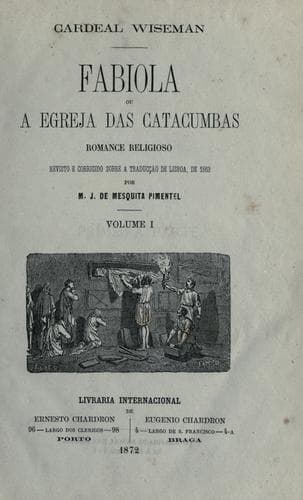
Fabiola; Or, The Church of the CatacombsWiseman, Nicholas Patrick
HistoryHistory
Fabiola; Or, The Church of the Catacombs
Wiseman, Nicholas Patrick
Christian fiction; Church history -- Primitive and early church, ca. 30-600 -- Fiction; Historical fiction
“I don’t believe a word of it,” observed Proculus. “There is no such
power in magic; and certainly I don’t see why these wretched men should
possess it more than their betters. Come, Calpurnius,” he continued,
“put by that old book, and answer these questions. I learnt more, one
day after dinner, about these Christians from you, than I had heard in
all my life before. What a wonderful memory you must have, to remember
so accurately the genealogy and history of that barbarous people! Is
what Scaurus has just told us possible, or not?”
Calpurnius delivered himself, with great pompousness, as follows:
“There is no reason to suppose such a thing impossible; for the power of
magic has no bounds. To prepare a powder that would make a man fly in
the air, it would be only necessary to find some herbs in which air
predominates more than the other three elements. Such for instance are
pulse, or lentils, according to Pythagoras. These, being gathered when
the sun is in Libra, the nature of which is to balance even heavy things
in the air, at the moment of conjunction with Mercury, a winged power as
you know, and properly energized by certain mysterious words, by a
skilful magician, then reduced to powder in a mortar made out of an
aerolite, or stone that had flown up into the sky, and come down again,
would no doubt, when rightly used, enable, or force a person to fly up
into the air. It is well known, indeed, that the Thessalian witches go
at pleasure through the clouds, from place to place, which must be done
by means of some such charm.
“Then, as to the Christians; you will remember, excellent Proculus, that
in the account to which you have done me the honor to allude, which was
at the deified Fabius’s table, if I remember right, I mentioned that the
sect came originally from Chaldæa, a country always famous for its
occult arts. But we have a most important evidence bearing on this
matter, recorded in history. It is quite certain, that here in Rome, a
certain Simon, who was sometimes called Simon Peter, and at other times
Simon Magus, actually in public flew up high into the air; but his charm
having slipped out of his belt, he fell and broke both his legs; for
which reason he was obliged to be crucified with his head downwards.”
“Then are all Christians necessarily sorcerers?” asked Scaurus.
“Necessarily; it is part of their superstition. They believe their
priests to have most extraordinary power over nature. Thus, for example,
they think they can bathe the bodies of people in water, and their souls
acquire thereby wonderful gifts and superiority, should they be slaves,
over their masters, and the divine emperors themselves.”
“Dreadful!” all cried out.
Public-domain text, read in full here on John Shaqi.
Reviews
Reviews
No reviews yet
Be the first to share your thoughts on this work.
Elsewhere in the archive
Join the Discussion
Join the discussion
Sign in to leave a comment or review.
Sign InorCreate an account