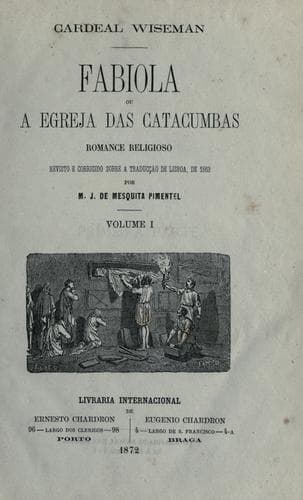
Fabiola; Or, The Church of the CatacombsWiseman, Nicholas Patrick
HistoryHistory
Fabiola; Or, The Church of the Catacombs
Wiseman, Nicholas Patrick
Christian fiction; Church history -- Primitive and early church, ca. 30-600 -- Fiction; Historical fiction
“Then, again,” resumed Calpurnius, “we all know what a frightful crime
some of them committed last night, in tearing down a supreme edict of
the imperial deities; and even suppose (which the gods avert) that they
carried their treasons still further, and attempted their sacred lives,
they believe that they have only to go to one of those priests, own the
crime, and ask for pardon; and, if he gives it, they consider themselves
as perfectly guiltless.”
“Fearful!” joined in the chorus.
“Such a doctrine,” said Scaurus, “is incompatible with the safety of the
state. A man who thinks he can be pardoned by another man of every
crime, is capable of committing any.”
“And that, no doubt,” observed Fulvius, “is the cause of this new and
terrible edict against them. After what Calpurnius has told us about
these desperate men, nothing can be too severe against them.”
Fulvius had been keenly eyeing Sebastian, who had entered during the
conversation; and now pointedly addressed him.
“And you, no doubt, think so too, Sebastian; do you not?”
“I think,” he calmly replied, “that if the Christians be such as
Calpurnius describes them, infamous sorcerers, they deserve to be
exterminated from the face of the earth. But even so, I would gladly
give them one chance of escape.”
“And what is that?” sneeringly asked Fulvius.
“That no one should be allowed to join in destroying them, who could not
prove himself freer from crime than they. I would have no one raise his
hand against them, who cannot show that he has never been an adulterer,
an extortioner, a deceiver, a drunkard, a bad husband, father, or child,
a profligate, or a thief. For with being any of these, no one charges
the poor Christians.”[144]
Fulvius winced under the catalogue of vices, and still more under the
indignant, but serene, glance of Sebastian. But at the word “thief,” he
fairly leapt. Had the soldier seen him pick up the scarf in Fabius’s
house? Be it so or not, the dislike he had taken to Sebastian, at their
first meeting, had ripened into hatred at their second; and hatred in
that heart was only written in blood. He had only intensity now to add
to that feeling.
Sebastian went out; and his thoughts got vent in familiar words of
prayer. “How long, O Lord! how long? What hopes can we entertain of the
conversion of many to the truth, still less of the conversion of this
great empire, so long as we find even honest and learned men believing
at once every calumny spoken against us; treasuring up, from age to age,
every fable and fiction about us; and refusing even to inquire into our
doctrines, because they have made up their minds that they are false and
contemptible?”
Public-domain text, read in full here on John Shaqi.
Reviews
Reviews
No reviews yet
Be the first to share your thoughts on this work.
Elsewhere in the archive
Join the Discussion
Join the discussion
Sign in to leave a comment or review.
Sign InorCreate an account