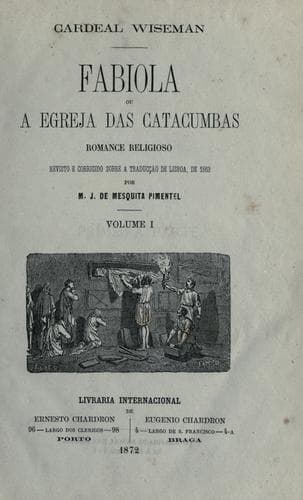
Fabiola; Or, The Church of the CatacombsWiseman, Nicholas Patrick
HistoryHistory
Fabiola; Or, The Church of the Catacombs
Wiseman, Nicholas Patrick
Christian fiction; Church history -- Primitive and early church, ca. 30-600 -- Fiction; Historical fiction
But Corvinus, after getting over his first dismay, and having as
speedily as possible another, though not so grand, a copy of the edict
affixed, began better to see the dismal probabilities of serious
consequences from the wrath of his imperial master. The Dacian was
right: _he_ would have to answer for the loss. He felt it necessary to
do something that very day, which might wipe off the disgrace he had
incurred, before again meeting the emperor’s look. He determined to
anticipate the attack on the cemetery, intended for the following day.
He repaired, therefore, while it was still early, to the baths, where
Fulvius, ever jealously watchful over Torquatus, kept him in expectation
of Corvinus’s coming to hold council with them. The worthy trio
concerted their plans. Corvinus, guided by the reluctant apostate, at
the head of a chosen band of soldiers who were at his disposal, had to
make an incursion into the cemetery of Callistus, and drive, or drag,
thence the clergy and principal Christians; while Fulvius, remaining
outside with another company, would intercept them and cut off all
retreat, securing the most important prizes, and especially the Pontiff
and superior clergy, whom his visit to the ordination would enable him
to recognize. This was his plan. “Let fools,” he said to himself, “act
the part of ferrets in the warren; I will be the sportsman outside.”
In the meantime Victoria overheard sufficient to make her very busy
dusting and cleaning, in the retired room where they were consulting,
without appearing to listen. She told all to Cucumio; and he, after much
scratching of his head, hit upon a notable plan for conveying the
discovered information to the proper quarter.
Sebastian, after his early attendance on divine worship, unable, from
his duties at the palace to do more, had proceeded, according to almost
universal custom, to the baths, to invigorate his limbs by their healthy
refreshment, and also to remove from himself the suspicion, which his
absence on that morning might have excited. While he was thus engaged,
the old _capsararius_, as he had had himself rattlingly called in his
ante-posthumous inscription, wrote on a slip of parchment all that his
wife had heard about the intention of an immediate assault, and of
getting possession of the holy Pontiff’s person. This he fastened with a
pin or needle to the inside of Sebastian’s tunic, of which he had
charge, as he durst not speak to him in the presence of others.
Public-domain text, read in full here on John Shaqi.
Reviews
Reviews
No reviews yet
Be the first to share your thoughts on this work.
Elsewhere in the archive
Join the Discussion
Join the discussion
Sign in to leave a comment or review.
Sign InorCreate an account