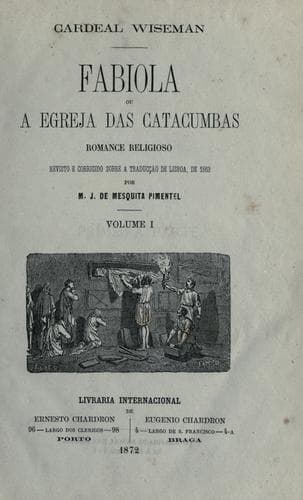
Fabiola; Or, The Church of the Catacombs — John Shaqi
Fabiola; Or, The Church of the CatacombsWiseman, Nicholas Patrick
HistoryHistory
Fabiola; Or, The Church of the Catacombs
Wiseman, Nicholas Patrick
Christian fiction; Church history -- Primitive and early church, ca. 30-600 -- Fiction; Historical fiction
It is a youth full of grace, and sprightliness, and candor, that comes
forward with light and buoyant steps across the atrium, towards the
inner-hall; and we shall hardly find time to sketch him before he
reaches it. He is about fourteen years old, but tall for that age, with
elegance of form and manliness of bearing. His bare neck and limbs are
well developed by healthy exercise; his features display an open and
warm heart, while his lofty forehead, round which his brown hair
naturally curls, beams with a bright intelligence. He wears the usual
youth’s garment, the short _prætexta_, reaching below the knee, and a
golden _bulla_, or hollow spheroid of gold suspended round his neck. A
bundle of papers and vellum rolls fastened together, and carried by an
old servant behind him, shows us that he is just returning home from
school.[4]
While we have been thus noting him, he has received his mother’s
embrace, and has sat himself low by her feet. She gazes upon him for
some time in silence, as if to discover in his countenance the cause of
his unusual delay, for he is an hour late in his return. But he meets
her glance with so frank a look, and with such a smile of innocence,
that every cloud of doubt is in a moment dispelled, and she addresses
him as follows:
“What has detained you to-day, my dearest boy? No accident, I trust, has
happened to you on the way?”
“Oh, none, I assure you, sweetest[5] mother; on the contrary, all has
been delightful,--so much so, that I can scarcely venture to tell you.”
A look of smiling expostulation drew from the open-hearted boy a
delicious laugh, as he continued:
“Well, I suppose I must. You know I am never happy, and cannot sleep, if
I have failed to tell you all the bad and the good of the day about
myself.” (The mother smiled again, wondering what the bad was.) “I was
reading the other day that the Scythians each evening cast into an urn a
white or a black stone, according as the day had been happy or unhappy;
if I had to do so, it would serve to mark, in white or black, the days
on which I have, or have not, an opportunity of relating to you all that
I have done. But to-day, for the first time, I have a doubt, a fear of
conscience, whether I ought to tell you all.”
Did the mother’s heart flutter more than usual, as from a first anxiety,
or was there a softer solicitude dimming her eye, that the youth should
seize her hand and put it tenderly to his lips, while he thus replied?
“Fear nothing, mother most beloved, your son has done nothing that may
give you pain. Only say, do you wish to hear _all_ that has befallen me
to-day, or only the cause of my late return home?”
“Tell me all, dear Pancratius,” she answered; “nothing that concerns you
can be indifferent to me.”
Public-domain text, read in full here on John Shaqi.
Reviews
Reviews
No reviews yet
Be the first to share your thoughts on this work.
Join the Discussion
Join the discussion
Sign in to leave a comment or review.
Sign InorCreate an account