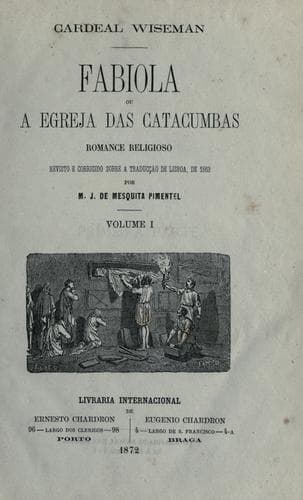
Fabiola; Or, The Church of the CatacombsWiseman, Nicholas Patrick
HistoryHistory
Fabiola; Or, The Church of the Catacombs
Wiseman, Nicholas Patrick
Christian fiction; Church history -- Primitive and early church, ca. 30-600 -- Fiction; Historical fiction
“They are not so, most noble sir. For in the midst of what you call
darkness, I see a spot of what I must call light, it contrasts so
strongly with all around. It is to me what the sun is to you, which I
know to be local from the varying direction of its rays. And this object
looks upon me as with a countenance of intensest beauty, and smiles upon
me ever. And I know it to be that of Him whom I love with undivided
affection. I would not for the world have its splendor dimmed by a
brighter sun, nor its wondrous loveliness confounded with the
diversities of others’ features, nor my gaze on it drawn aside by
earthly visions. I love Him too much not to wish to see Him always
alone.”
“Come, come! let me have no more of this silly prattle. Obey the
emperors at once, or I must try what a little pain will do. That will
soon tame thee.”
“Pain?” she echoed innocently.
“Yes, pain. Hast thou never felt it? hast thou never been hurt by any
one in thy life?”
“Oh, no! Christians never hurt one another.”
The rack was standing, as usual, before him; and he made a sign to
Catulus to place her upon it. The executioner pushed her back on it by
her arms; and as she made no resistance, she was easily laid extended on
its wooden couch. The loops of the ever-ready ropes were in a moment
passed round her ankles, and arms drawn over the head. The poor
sightless girl saw not who did all this; she knew not but it might be
the same person who had been conversing with her. If there had been
silence hitherto, men now held their very breath; while Cæcilia’s lips
moved in earnest prayer.
“Once more, before proceeding further, I call on thee to sacrifice to
the gods, and escape cruel torments,” said the judge, with a sterner
voice.
“Neither torments nor death,” firmly replied the victim tied to the
altar, “shall separate me from the love of Christ. I can offer up no
sacrifice but to the one living God: and its ready oblation is myself.”
The prefect made a signal to the executioner, and he gave one rapid
whirl to the two wheels of the rack, round the windlasses of which the
ropes were wound; and the limbs of the maiden were stretched with a
sudden jerk, which, though not enough to wrench them from their sockets,
as a further turn would have done, sufficed to inflict an excruciating,
or more truly, a _racking_ pain, through all her frame. Far more
grievous was this, from the preparation and the cause of it being
unseen, and from that additional suffering which darkness inflicts. A
quivering of her features and a sudden paleness alone gave evidence of
her torture.
“Ha! ha!” the judge exclaimed, “thou feelest that? Come, let it suffice;
obey, and thou shalt be freed.”
Public-domain text, read in full here on John Shaqi.
Reviews
Reviews
No reviews yet
Be the first to share your thoughts on this work.
Elsewhere in the archive
Join the Discussion
Join the discussion
Sign in to leave a comment or review.
Sign InorCreate an account