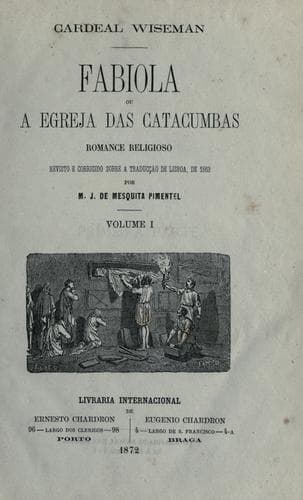
Fabiola; Or, The Church of the CatacombsWiseman, Nicholas Patrick
HistoryHistory
Fabiola; Or, The Church of the Catacombs
Wiseman, Nicholas Patrick
Christian fiction; Church history -- Primitive and early church, ca. 30-600 -- Fiction; Historical fiction
Having got all that he desired, he consigned his prisoner to Corvinus at
the gates of the Æmilian basilica, and left her to her fate. It had been
a cold and drizzling day like the preceding evening. The weather, and
the incident of the night, had kept down all enthusiasm; and while the
prefect had been compelled to sit in-doors, where no great crowd could
collect, as hours had passed away without any arrest, trial, or tidings,
most of the curious had left, and only a few more persevering remained,
past the hour of afternoon recreation in the public gardens. But just
before the captive arrived, a fresh knot of spectators came in, and
stood near one of the side-doors, from which they could see all.
As Corvinus had prepared his father for what he was to expect,
Tertullus, moved with some compassion, and imagining there could be
little difficulty in overcoming the obstinacy of a poor, ignorant, blind
beggar, requested the spectators to remain perfectly still, that he
might try his persuasion on her, alone, as she would imagine, with him;
and he threatened heavy penalties on any one who should presume to break
the silence.
It was as he had calculated. Cæcilia knew not that any one else was
there, as the prefect thus kindly addressed her:
“What is thy name, child?”
“Cæcilia.”
“It is a noble name; hast thou it from thy family?”
“No; I am not noble; except because my parents, though poor, died for
Christ. As I am blind, those who took care of me called me _Cæca_,[153]
and then, out of kindness, softened it into Cæcilia.”
“But now, give up all this folly of the Christians, who have kept thee
only poor and blind. Honor the decrees of the divine emperors, and offer
sacrifice to the gods; and thou shalt have riches, and fine clothes, and
good fare; and the best physicians shall try to restore thee thy sight.”
“You must have better motives to propose to me than these; for the very
things for which I most thank God and His Divine Son, are those which
you would have me put away.”
“How dost thou mean?”
“I thank God that I am poor and meanly clad, and fare not daintily;
because by all these things I am the more like Jesus Christ, my only
Spouse.”
“Foolish girl!” interrupted the judge, losing patience a little; “hast
thou learnt all these silly delusions already? at least thou canst not
thank thy God that He has made thee sightless.”
“For that, more than all the rest, I thank Him daily and hourly with all
my heart.”
“How so? dost thou think it a blessing never to have seen the face of a
human being, or the sun, or the earth? What strange fancies are these?”
Public-domain text, read in full here on John Shaqi.
Reviews
Reviews
No reviews yet
Be the first to share your thoughts on this work.
Elsewhere in the archive
Join the Discussion
Join the discussion
Sign in to leave a comment or review.
Sign InorCreate an account