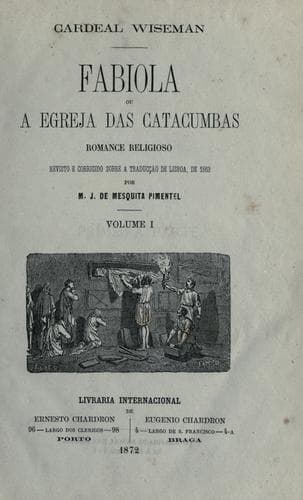
Fabiola; Or, The Church of the CatacombsWiseman, Nicholas Patrick
HistoryHistory
Fabiola; Or, The Church of the Catacombs
Wiseman, Nicholas Patrick
Christian fiction; Church history -- Primitive and early church, ca. 30-600 -- Fiction; Historical fiction
“You are not hurt, I hope, Corvinus?”
“No, no; let me go, Quadratus, let me go.”
“Where are you running to in such a hurry? can I help you?” asked his
captor, still holding him fast.
“Let me loose, I say, or he will be gone.”
“Who will be gone?”
“Pancratius,” answered Corvinus, “who just now insulted my father.”
“Pancratius!” said Quadratus, looking round, and seeing that he had got
clear off; “I do not see him.” And he let him go; but it was too late.
The youth was safe at Diogenes’s, in the Suburra.
While this scene was going on, the prefect, mortified, ordered Catulus
to see the body thrown into the Tiber. But another officer, muffled in
his cloak, stepped aside and beckoned to Catulus, who understood the
sign, and stretched out his hand to receive a purse held out to him.
“Out of the Porta Capena, at Lucina’s villa, an hour after sunset,” said
Sebastian.
“It shall be delivered there safe,” said the executioner.
“Of what do you think did that poor girl die?” asked a spectator from
his companion, as they went out.
“Of fright, I fancy,” he replied.
[Illustration: The Woman of Samaria, from a picture in the Cemetery of
St. Domitilla.]
“Of Christian modesty,” interposed a stranger who passed them.
CHAPTER XVIII.
RETRIBUTION.
The prefect of the city went to give his report on the untoward events
of the day, and do what was possible to screen his worthless son. He
found the emperor in the worst of moods. Had Corvinus come in his way
early in the day, nobody could have answered for his head. And now the
result of the inroad into the cemetery had revived his anger, when
Tertullus entered into the audience-chamber. Sebastian contrived to be
on guard.
“Where is your booby of a son?” was the first salutation which the
prefect received.
“Humbly waiting your divinity’s pleasure outside, and anxious to
propitiate your godlike anger, for the tricks which fortune has played
upon his zeal.”
“Fortune!” exclaimed the tyrant; “fortune indeed! His own stupidity and
cowardice: a pretty beginning, forsooth; but he shall smart for it.
Bring him in.”
The wretch, whining and trembling, was introduced; and cast himself at
the emperor’s feet, from which he was spurned, and sent rolling, like a
lashed hound, into the midst of the hall. This set the imperial divinity
a-laughing, and helped to mollify its wrath.
“Come, sirrah! stand up,” he said, “and let me hear an account of
yourself. How did the edict disappear?”
Corvinus told a rambling tale, which occasionally amused the emperor;
for he was rather taken with the trick. This was a good symptom.
“Well,” he said at last, “I will be merciful to you. Lictors, bind your
fasces.” They drew their axes forth, and felt their edges. Corvinus
again threw himself down, and exclaimed:
“Spare my life; I have important information to furnish, if I live.”
“Who wants your worthless life?” responded the gentle Maximian.
“Lictors, put aside your axes; the rods are good enough for him.”
Public-domain text, read in full here on John Shaqi.
Reviews
Reviews
No reviews yet
Be the first to share your thoughts on this work.
Elsewhere in the archive
Join the Discussion
Join the discussion
Sign in to leave a comment or review.
Sign InorCreate an account