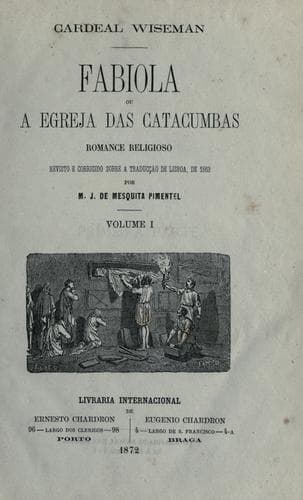
Fabiola; Or, The Church of the CatacombsWiseman, Nicholas Patrick
HistoryHistory
Fabiola; Or, The Church of the Catacombs
Wiseman, Nicholas Patrick
Christian fiction; Church history -- Primitive and early church, ca. 30-600 -- Fiction; Historical fiction
In a moment his hands were seized and bound, his tunic was stripped off
his shoulders, and a shower of blows fell upon them, delivered with
well-regulated skill, till he roared and writhed, to the great enjoyment
of his imperial master.
Smarting and humbled, he had to stand again before him.
“Now, sir,” said the latter, “what is the wonderful information you have
to give?”
“That I know who perpetrated the outrage of last night, on your imperial
edict.”
“Who was it?”
“A youth named Pancratius, whose knife I found under where the edict had
been cut away.”
“And why have you not seized him and brought him to justice?”
“Twice this day he has been almost within my grasp, for I have heard his
voice; but he has escaped me.”
“Then let him not escape a third time, or you may have to take his
place. But how do you know him, or his knife?”
“He was my school-fellow at the school of Cassianus, who turned out to
be a Christian.”
“A Christian presume to teach my subjects, to make them enemies of their
country, disloyal to their sovereigns, and contemners of the gods! I
suppose it was he who taught that young viper Pancratius to pull down
our imperial edict. Do you know where he is?”
“Yes, sire; Torquatus, who has abandoned the Christian superstition, has
told me.”
“And pray who is this Torquatus?”
“He is one who has been staying some time with Chromatius and a party of
Christians in the country.”
“Why, this is worse and worse. Is the ex-prefect then, too, become a
Christian?”
“Yes, and lives with many others of that sect in Campania.”
“What perfidy! what treachery! I shall not know whom to trust next.
Prefect, send some one immediately to arrest all these men, and the
school-master, and Torquatus.”
“He is no longer a Christian,” interposed the judge.
“Well, what do I care?” replied the emperor peevishly; “arrest as many
as you can, and spare no one, and make them smart well; do you
understand me? Now begone, all; it is time for my supper.”
Corvinus went home; and, in spite of medicinal applications, was
feverish, sore, and spiteful all night; and next morning begged his
father to let him go on the expedition into Campania, that so he might
retrieve his honor, gratify his revenge, and escape the disgrace and
sarcasm that was sure to be heaped on him by Roman society.
When Fulvius had deposited his prisoner at the tribunal, he hastened
home to recount his adventures, as usual, to Eurotas. The old man
listened with imperturbable sternness to the barren recital, and at last
said, coldly:
“Very little profit from all this, Fulvius.”
“No immediate profit, indeed; but a good prospect in view, at least.”
“How so?”
“Why, the Lady Agnes is in my power. I have made sure, at last, that
she is a Christian. I can now necessarily either win her or destroy her.
In either case her property is mine.”
“Take the second alternative,” said the old man, with a keen glow in his
eye, but no change of face; “it is the shorter, and less troublesome,
way.”
Public-domain text, read in full here on John Shaqi.
Reviews
Reviews
No reviews yet
Be the first to share your thoughts on this work.
Elsewhere in the archive
Join the Discussion
Join the discussion
Sign in to leave a comment or review.
Sign InorCreate an account