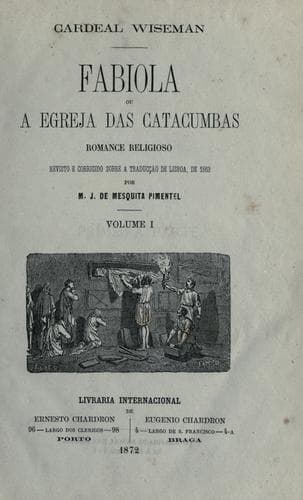
Fabiola; Or, The Church of the CatacombsWiseman, Nicholas Patrick
HistoryHistory
Fabiola; Or, The Church of the Catacombs
Wiseman, Nicholas Patrick
Christian fiction; Church history -- Primitive and early church, ca. 30-600 -- Fiction; Historical fiction
Was he dead too? he thought. Why not? Darkness, complete and perpetual,
had come upon him. He was cut off for ever from consort with the living,
his mouth would no more taste food, his ears never again hear a sound,
his eyes behold no light, or thing, again. He was associated with the
dead, only his grave was much larger than theirs; but, for all that, it
was as dark and lonely, and closed for ever. What else is death?
No, it could not be death as yet. Death had to be followed by something
else. But even this was coming. The worm was beginning to gnaw his
conscience, and it grew apace to a viper’s length, and twisted itself
round his heart. He tried to think of pleasant things, and they came
before him; the quiet hours in the villa with Chromatius and Polycarp,
their kind words, and last embrace. But from the beautiful vision darted
a withering flash; he had betrayed them; he had told of them; to whom?
To Fulvius and Corvinus. The fatal chord was touched, like the tingling
nerve of a tooth, that darts its agony straight to the centre of the
brain. The drunken debauch, the dishonest play, the base hypocrisy, the
vile treachery, the insincere apostasy, the remorseful sacrileges, of
the last days, and the murderous attempt of that morning, now came
dancing, like demons hand in hand, in the dark before him, shouting,
laughing, jibing, weeping, moaning, gnashing their teeth; and sparks of
fire flying before his eyes, from his enfeebled brain, seemed to dart
from glaring torches in their hands. He sunk down and covered his eyes.
“I may be dead, after all,” he said to himself; “for the infernal pit
can have nothing worse than this.”
His heart was too weak for rage; it sunk within him in the impotence of
despair. His strength was ebbing fast, when he fancied he heard a
distant sound. He put away the thought; but the wave of a remote harmony
beat again upon his ear. He raised himself up; it was becoming distinct.
So sweet it sounded, so like a chorus of angelic voices, but in another
sphere, that he said to himself: “Who would have thought that Heaven was
so near to hell! Or are they accompanying the fearful Judge to try me?”
And now a faint glimmer of light appeared at the same distance as the
sounds; and the words of the strain were clearly heard:
“In pace, in idipsum, dormiam et requiescam.”[156]
“Those words are not for me. They might do at a martyr’s entombment;
they cannot at a reprobate’s burial.”
Public-domain text, read in full here on John Shaqi.
Reviews
Reviews
No reviews yet
Be the first to share your thoughts on this work.
Elsewhere in the archive
Join the Discussion
Join the discussion
Sign in to leave a comment or review.
Sign InorCreate an account