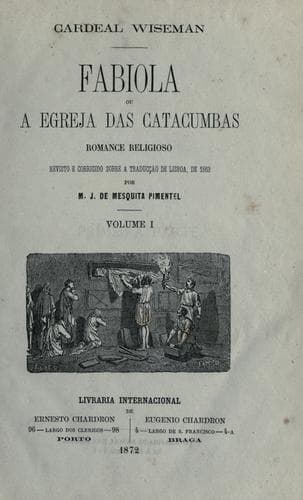
Fabiola; Or, The Church of the CatacombsWiseman, Nicholas Patrick
HistoryHistory
Fabiola; Or, The Church of the Catacombs
Wiseman, Nicholas Patrick
Christian fiction; Church history -- Primitive and early church, ca. 30-600 -- Fiction; Historical fiction
The light increased; it was like a dawn glowing into day; it entered the
gallery and passed across it, bearing in it, as in a mirror, a vision
too distinct to be unreal. First, there came virgins robed and holding
lamps; then four who carried between them a form wrapped up in a white
linen cloth, with a crown of thorns upon the head; after them the
youthful acolyte Tarcisius bearing a censer steaming with perfumed
smoke; and, after others of the clergy, the venerable Pontiff himself,
attended by Reparatus, and another deacon. Diogenes and his sons, with
sorrowful countenances, and many others, among whom he could distinguish
Sebastian, closed the procession. As many bore lamps or tapers, the
figures seemed to move in an unchanging atmosphere of mildest light.
And as they passed before him, they chanted the next verse of the psalm:
“Quoniam Tu Domine singulariter in spe constituisti me.”[157]
“_That_,” he exclaimed, rousing himself up, “_that_ is for me.”
With this thought he had sprung upon his knees; and by an instinct of
grace words which he had before heard came back to him like an echo;
words suited to the moment; words which he felt that he _must_ speak. He
crept forward, faint and feeble, turned along the gallery through which
the funeral procession was passing, and followed it, unobserved, at a
distance. It entered a chamber and lighted it up, so that a picture
[Illustration: The Martyr’s Burial.]
of the Good Shepherd looked brightly down on him. But he would not pass
the threshold, where he stood striking his breast and praying for mercy.
The body had been laid upon the ground, and other psalms and hymns were
sung, and prayers recited, all in that cheerful tone and joyous mood of
hopefulness, with which the Church has always treated of death. At
length it was placed in the tomb prepared for it, under an arch. While
this was being done, Torquatus drew nigh to one of the spectators, and
whispered to him the question:
“Whose funeral is this?”
“It is the _deposition_,” he answered, “of the blessed Cæcilia, a blind
virgin, who this morning fell into the hands of the soldiers, in this
cemetery, and whose soul God took to Himself.”
“Then I am her murderer,” he exclaimed, with a hollow moan; and
staggering forward to the holy bishop’s feet, fell prostrate before him.
It was some time before his feelings could find vent in words; when
these came, they were the ones he had resolved to utter:
“Father, I have sinned before heaven, and against Thee, and I am not
worthy to be called Thy child.”
The Pontiff raised him up kindly, and pressed him to his bosom, saying,
“Welcome back, my son, whoever thou art, to thy Father’s house. But thou
art weak and faint, and needest rest.”
Public-domain text, read in full here on John Shaqi.
Reviews
Reviews
No reviews yet
Be the first to share your thoughts on this work.
Elsewhere in the archive
Join the Discussion
Join the discussion
Sign in to leave a comment or review.
Sign InorCreate an account