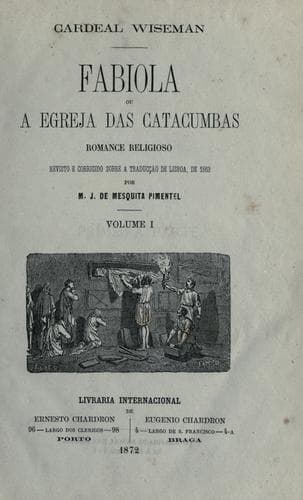
Fabiola; Or, The Church of the CatacombsWiseman, Nicholas Patrick
HistoryHistory
Fabiola; Or, The Church of the Catacombs
Wiseman, Nicholas Patrick
Christian fiction; Church history -- Primitive and early church, ca. 30-600 -- Fiction; Historical fiction
It is far from our intention to harrow the feelings of our gentle
readers by descriptions of the cruel and fiendish torments inflicted by
the heathen persecutors on our Christian forefathers. Few are more
horrible, yet few better authenticated, than the torture practised on
the martyr Cassianus. Placed, bound, in the midst of his ferocious young
tigers, he was left to be the lingering victim of their feeble cruelty.
Some, as the Christian poet Prudentius tells us, cut their tasks upon
him with the steel points used in engraving writing on wax-covered
tablets; others exercised the ingenuity of a precocious brutality, by
inflicting every possible torment on his lacerated body. Loss of blood,
and acute pain, at length exhausted him, and he fell on the floor
without power to rise. A shout of exultation followed, new insults were
inflicted, and the troop of youthful demons broke loose, to tell the
story of their sport at their respective homes. To give Christians
decent burial never entered into the minds of their persecutors; and
Corvinus, who had glutted his eyes with the spectacle of his vengeance,
and had urged on the first efforts at cruelty of his ready instruments,
left the expiring man where he lay, to die unnoticed. His faithful
servant, however, raised him up, and laid him on his bed, and sent a
token, as he had preconcerted, to Pancratius, who was soon at his side,
while his companion looked after preparations for their departure. The
youth was horrified at what he beheld, and at the recital of his old
master’s exquisite torture, as he was edified by the account of his
patience. For not a word of reproach had escaped him, and prayer alone
had occupied his thoughts and tongue.
Cassianus recognized his dear pupil, smiled upon him, pressed his hand
in his own, but could not speak. After lingering till morning he
placidly expired. The last rites of Christian sepulture were modestly
paid to him on the spot, for the house was his; and Pancratius hurried
from the scene, with a heavy heart and a no slight rising of its
indignation, against the heartless savage who had devised and witnessed,
without remorse, such a tragedy.
He was mistaken, however. No sooner was his revenge fulfilled than
Corvinus felt all the disgrace and shame of what he had done; he feared
it should be known to his father, who had always esteemed Cassianus; he
feared the anger of the parents, whose children he had that day
effectually demoralized, and fleshed to little less than parricide. He
ordered his horses to be harnessed, but was told they must have some
more hours’ rest. This increased his displeasure; remorse tormented
him, and he sat down to drink, and so drown care and pass time. At
length he started on his journey, and after baiting for an hour or two,
pushed on through the night. The road was heavy from continued rain, and
ran along the side of the great canal which drains the Pontine marshes,
and between two rows of trees.
Public-domain text, read in full here on John Shaqi.
Reviews
Reviews
No reviews yet
Be the first to share your thoughts on this work.
Elsewhere in the archive
Join the Discussion
Join the discussion
Sign in to leave a comment or review.
Sign InorCreate an account