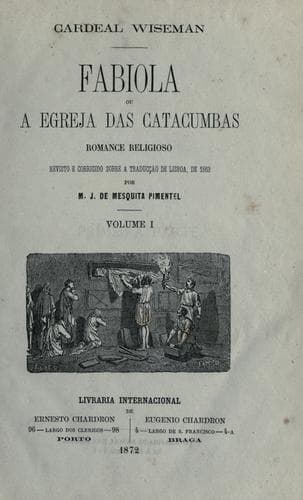
Fabiola; Or, The Church of the CatacombsWiseman, Nicholas Patrick
HistoryHistory
Fabiola; Or, The Church of the Catacombs
Wiseman, Nicholas Patrick
Christian fiction; Church history -- Primitive and early church, ca. 30-600 -- Fiction; Historical fiction
Corvinus had drunk again at his halt, and was heated with wine,
vexation, and remorse. The dragging pace of his jaded steeds provoked
him, and he kept lashing them furiously on. While they were thus excited
they heard the tramp of horses coming fast on behind, and dashed forward
at an uncontrollable speed. The attendants were soon left at a distance,
and the frightened horses passed between the trees on to the narrow path
by the canal, and galloped forward, rocking the chariot from side to
side at a reckless rate. The horsemen behind hearing the violent rush of
hoofs and wheels, and the shout of the followers, clapped spurs to their
horses, and pushed gallantly forward. They had passed the runners some
way when they heard a crash and a plunge. The wheel had struck the trunk
of a tree, the chariot had turned over, and its half-drunken driver had
been tossed head over heels into the water. In a moment Pancratius was
off his horse and by the side of the canal, together with his companion.
By the faint light of the rising moon, and by the sound of his voice,
the youth recognized Corvinus struggling in the muddy stream. The side
was not deep, but the high clayey bank was wet and slimy, and every time
he attempted to climb it his foot slipped, and he fell back into the
deep water in the middle. He was, in fact, already becoming benumbed and
exhausted by his wintry bath.
“It would serve him right to leave him there,” muttered the rough
centurion.
“Hush, Quadratus! how can you say so? give me hold of your hand. So!”
said the youth, leaning over the bank and seizing his enemy by his arm,
just as he was relaxing his hold on a withered shrub, and falling back
fainting into the stream. It would have been his last plunge. They
pulled him out and laid him on the road, a pitiable figure for his
greatest foe. They chafed his temples and hands, and he had begun to
revive when his attendants came up. To their care they consigned him,
together with his purse, which had fallen from his belt as they drew him
from the canal. But Pancratius took possession of his own pen-knife,
which dropped out with it, and which Corvinus carried about him, as
evidence to convict him of having cut down the edict. The servants
pretended to Corvinus, when he had regained consciousness, that they had
drawn him out of the water, but that his purse must have been lost in
it, and lay still buried in the deep mud. They bore him to a neighboring
cottage, while the carriage was being repaired, and had a good carouse
with his money while he slept.
[Illustration: The Anchor and Fish, emblematic of Christianity, found in
the Catacombs.]
Two acts of revenge had been thus accomplished in one day,--the pagan
and the Christian.
CHAPTER XX.
THE PUBLIC WORKS.
Public-domain text, read in full here on John Shaqi.
Reviews
Reviews
No reviews yet
Be the first to share your thoughts on this work.
Elsewhere in the archive
Join the Discussion
Join the discussion
Sign in to leave a comment or review.
Sign InorCreate an account