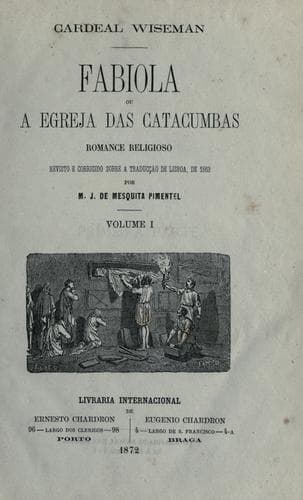
Fabiola; Or, The Church of the CatacombsWiseman, Nicholas Patrick
HistoryHistory
Fabiola; Or, The Church of the Catacombs
Wiseman, Nicholas Patrick
Christian fiction; Church history -- Primitive and early church, ca. 30-600 -- Fiction; Historical fiction
Such an occasion was now approaching. The persecution had lingered. No
person of note had been yet captured; the failures of the first day had
not been fully repaired; and something more wholesale was expected. The
people demanded more sport; and an approaching imperial birthday
justified their gratification. The wild beasts, which Sebastian and
Pancratius had heard, yet roared for their lawful prey. “_Christianos ad
leones_” might seem to have been interpreted by them, as meaning “that
the Christians of right belonged to them.”
One afternoon, towards the end of December, Corvinus proceeded to the
Baths of Dioclesian, accompanied by Catulus, who had an eye for proper
combatants in the amphitheatre, such as a good dealer would have for
cattle at a fair. He called for Rabirius, the superintendent of the
convict department, and said to him:
“Rabirius, I am come by order of the emperor, to select a sufficient
number of the wicked Christians under your charge, for the honor of
fighting in the amphitheatre, on occasion of the coming festival.”
“Really,” answered the officer, “I have none to spare. I am obliged to
finish the work in a given time, and I cannot do so, if I am left short
of hands.”
“I cannot help that; others will be got to replace those that are taken
from you. You must walk Catulus and myself through your works, and let
us choose those that will suit us.”
Rabirius, grumbling at this unreasonable demand, submitted nevertheless
to it, and took them into a vast area, just vaulted over. It was entered
by a circular vestibule lighted from above, like the Pantheon. This led
into one of the shorter arms of a cruciform hall of noble dimensions,
into which opened a number of lesser, though still handsome, chambers.
At each angle of the hall, where the arms intersected one another, a
huge granite pillar of one block had to be erected. Two were already in
their places, one was girt with ropes delivered round capstans, ready to
be raised on the morrow. A number of men were actively employed in
making final preparations. Catulus nudged Corvinus, and pointed, with
his thumb, to two fine youths, who, stripped slave-fashion to their
waists, were specimens of manly athletic forms.
“I must have those two, Rabirius,” said the willing purveyor to wild
beasts; “they will do charmingly. I am sure they are Christians, they
work so cheerfully.”
“I cannot possibly spare them at present. They are worth six men, or a
pair of horses, at least, to me. Wait till the heavy work is over, and
then they are at your service.”
“What are their names, that I may take a note of them? And mind, keep
them up in good condition.”
“They are called Largus and Smaragdus; they are young men of excellent
family, but work like plebeians, and will go with you nothing loth.”
“They shall have their wish,” said Corvinus, with great glee. And so
they had later.
Public-domain text, read in full here on John Shaqi.
Reviews
Reviews
No reviews yet
Be the first to share your thoughts on this work.
Elsewhere in the archive
Join the Discussion
Join the discussion
Sign in to leave a comment or review.
Sign InorCreate an account