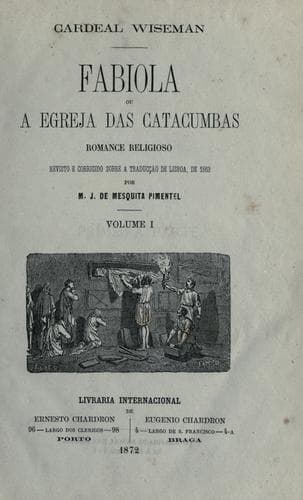
Fabiola; Or, The Church of the CatacombsWiseman, Nicholas Patrick
HistoryHistory
Fabiola; Or, The Church of the Catacombs
Wiseman, Nicholas Patrick
Christian fiction; Church history -- Primitive and early church, ca. 30-600 -- Fiction; Historical fiction
As they went through the works, however, they picked out a number of
captives, for many of whom Rabirius made resistance, but generally in
vain. At length they came near one of those chambers which flanked the
eastern side of the longer arm of the hall. In one of them they saw a
number of convicts (if we must use the term) resting after their labor.
The centre of the group was an old man, most venerable in appearance,
with a long white beard streaming on his breast, mild in aspect, gentle
in word, cheerful in his feeble action. It was the confessor Saturninus,
now in his eightieth year, yet loaded with two heavy chains. At each
side were the more youthful laborers, Cyriacus and Sisinnius, of whom it
is recorded, that, in addition to their own task-work, one on each side,
they bore up his bonds. Indeed, we are told that their particular
delight was, over and above their own assigned portion of toil, to help
their weaker brethren, and perform their work for them.[160] But their
time was not yet come; for both of them, before they received their
crowns, were ordained deacons in the next pontificate.
Several other captives lay on the ground, about the old man’s feet, as
he, seated on a block of marble, was talking to them, with a sweet
gravity, which riveted their attention, and seemed to make them forget
their sufferings. What was he saying to them? Was he requiting Cyriacus
for his extraordinary charity, by telling him that, in commemoration of
it, a portion of the immense pile which they were toiling to raise,
would be dedicated to God, under his invocation, become a title, and
close its line of titulars by an illustrious name?[161] Or was he
recounting another more glorious vision, how this smaller oratory was to
be superseded and absorbed by a glorious temple in honor of the Queen of
Angels, which should comprise the entire of that superb hall, with its
vestibule, under the directing skill of the mightiest artistic genius
that the world should ever see?[162] What more consoling thought could
have been vouchsafed to those poor oppressed captives, than that they
were not so much erecting baths for the luxury of a heathen people, or
the prodigality of a wicked emperor, as in truth building up one of the
stateliest churches in which the true God is worshipped, and the Virgin
Mother, who bore Him incarnate, is affectionately honored?
From a distance Corvinus saw the group; and pausing, asked the
superintendent the names of those who composed it. He enumerated them
readily; then added, “You may as well take that old man, if you like;
for he is not worth his keep, as far as work goes.”
Public-domain text, read in full here on John Shaqi.
Reviews
Reviews
No reviews yet
Be the first to share your thoughts on this work.
Elsewhere in the archive
Join the Discussion
Join the discussion
Sign in to leave a comment or review.
Sign InorCreate an account