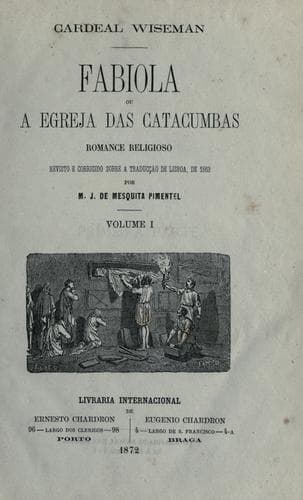
Fabiola; Or, The Church of the CatacombsWiseman, Nicholas Patrick
HistoryHistory
Fabiola; Or, The Church of the Catacombs
Wiseman, Nicholas Patrick
Christian fiction; Church history -- Primitive and early church, ca. 30-600 -- Fiction; Historical fiction
“Thank you,” replied Corvinus, “a pretty figure he would cut in the
amphitheatre. The people are not to be put off with decrepit old
creatures, whom a single stroke of a bear’s or tiger’s paw kills
outright. They like to see young blood flowing, and plenty of life
struggling against wounds and blows, before death comes to decide the
contest. But there is one there whom you have not named. His face is
turned from us; he has not the prisoner’s garb, nor any kind of fetter.
Who can it be?”
“I do not know his name,” answered Rabirius; “but he is a fine youth,
who spends much of his time among the convicts, relieves them, and even
at times helps them in their work. He pays, of course, well for being
allowed all this; so it is not our business to ask questions.”
“But it is mine, though,” said Corvinus, sharply; and he advanced for
this purpose. The voice caught the stranger’s ear, and he turned round
to look.
[Illustration: A Monogram of Christ, found in the Catacombs.]
Corvinus sprung upon him with the eye and action of a wild beast, seized
him, and called out, with exultation, “Fetter him instantly. This time
at least, Pancratius, thou shalt not escape.”
CHAPTER XXI.
THE PRISON.
If a modern Christian wishes really to know what his forefathers
underwent for the faith, during three centuries of persecution, we would
not have him content himself with visiting the catacombs, as we have
tried to make him do, and thus learning what sort of life they were
compelled to lead; but we would advise him to peruse those imperishable
records, the _Acts of the Martyrs_, which will show him how they were
made to die. We know of no writings so moving, so tender, so consoling,
and so ministering of strength to faith and to hope, after God’s
inspired words, as these venerable monuments. And if our reader, so
advised, have not leisure sufficient to read much upon this subject, we
would limit him willingly to one specimen, the genuine Acts of SS.
Perpetua and Felicitas. It is true that they will be best read by the
scholar in their plain African latinity; but we trust that some one will
soon give us a worthy English version of these, and some other similar,
early Christian documents. The ones which we have singled out are the
same as were known to St. Augustine, and cannot be read by any one
without emotion. If the reader would compare the morbid sensibility, and
the overstrained excitement, endeavored to be produced by a modern
French writer, in the imaginary journal of a culprit condemned to
death, down to the immediate approach of execution, with the unaffected
pathos, and charming truthfulness, which pervades the corresponding
narrative of Vivia Perpetua, a delicate lady of twenty-one years of age,
he would not hesitate in concluding, how much more natural, graceful,
and interesting are the simple recitals of Christianity, than the
boldest fictions of romance. And when our minds are sad, or the petty
Public-domain text, read in full here on John Shaqi.
Reviews
Reviews
No reviews yet
Be the first to share your thoughts on this work.
Elsewhere in the archive
Join the Discussion
Join the discussion
Sign in to leave a comment or review.
Sign InorCreate an account