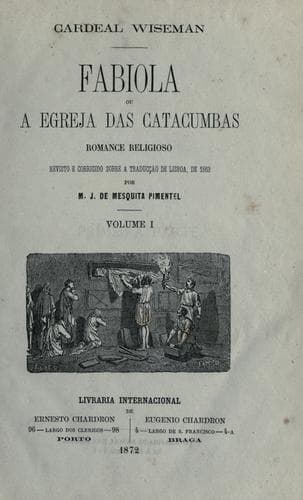
Fabiola; Or, The Church of the CatacombsWiseman, Nicholas Patrick
HistoryHistory
Fabiola; Or, The Church of the Catacombs
Wiseman, Nicholas Patrick
Christian fiction; Church history -- Primitive and early church, ca. 30-600 -- Fiction; Historical fiction
[Illustration: “Is it possible?” she exclaimed with terror, “is that
Tarcisius, whom I met a few moments ago, so fair and lovely?”]
an angel now, sleeping the martyr’s slumber, than he did when living
scarcely an hour before. Quadratus himself bore him to the cemetery of
Callistus, where he was buried amidst the admiration of older believers;
and later the holy Pope Damasus composed for him an epitaph, which no
one can read, without concluding that the belief in the real presence of
Our Lord’s Body in the Blessed Eucharist was the same then as now:
“Tarcisium sanctum Christi sacramenta gerentem,
Cum male sana manus peteret vulgare profanis;
Ipse animam potius voluit dimittere cæsus
Prodere quam canibus rabidis cœlestia membra.”[173]
He is mentioned in the Roman martyrology, on the 15th of August, as
commemorated in the cemetery of Callistus; whence his relics were, in
due time, translated to the church of St. Sylvester in Campo, as an old
inscription declares.
News of this occurrence did not reach the prisoners till after their
feast; and perhaps the alarm that they were to be deprived of the
spiritual food to which they looked forward for strength, was the only
one that could have overcast, even slightly, the serenity of their
souls. At this moment Sebastian entered, and perceived at once that some
unpleasant news had arrived, and as quickly divined what it was; for
Quadratus had already informed him of all. He cheered up, therefore, the
confessors of Christ; assured them that they should not be deprived of
their coveted food; then whispered a few words to Reparatus the deacon,
who flew out immediately with a look of bright intelligence.
Sebastian, being known to the guards, had passed freely in, and out of,
the prison daily; and had been indefatigable in his care of its inmates.
But now he was come to take his last farewell of his dearest friend,
Pancratius, who had longed for this interview. They drew to one side,
when the youth began:
“Well, Sebastian, do you remember when we heard the wild beasts roar,
from your window, and looked at the many gaping arches of the
amphitheatre, as open for the Christian’s triumph?”
“Yes, my dear boy; I remember that evening well, and it seemed to me as
if your heart anticipated then, the scenes that await you to-morrow.”
“It did, in truth. I felt an inward assurance that I should be one of
the first to appease the roaring fury of those deputies of human
cruelty. But now that the time is come, I can hardly believe myself
worthy of so immense an honor. What can I have done, Sebastian, not
indeed to deserve it, but to be chosen out as the object of so great a
grace?”
“You know, Pancratius, that it is not he who willeth, nor he that
runneth, but God who hath mercy, that maketh the election. But tell me
rather, how do you now feel about to-morrow’s glorious destiny?”
Public-domain text, read in full here on John Shaqi.
Reviews
Reviews
No reviews yet
Be the first to share your thoughts on this work.
Elsewhere in the archive
Join the Discussion
Join the discussion
Sign in to leave a comment or review.
Sign InorCreate an account