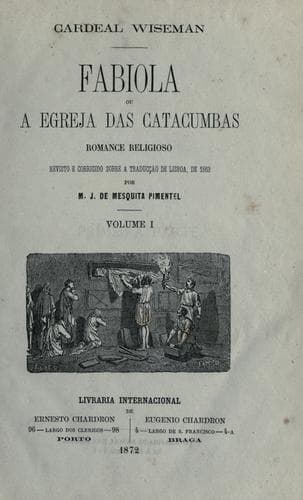
Fabiola; Or, The Church of the CatacombsWiseman, Nicholas Patrick
HistoryHistory
Fabiola; Or, The Church of the Catacombs
Wiseman, Nicholas Patrick
Christian fiction; Church history -- Primitive and early church, ca. 30-600 -- Fiction; Historical fiction
“What is it? what can it be?” one began to ask the other; when Fulvius
chanced to pass by, and joined the circle round the combatants. He at
once recognized Tarcisius, having seen him at the Ordination; and being
asked, as a better-dressed man, the same question, he replied
contemptuously, as he turned on his heel, “What is it? Why, only a
Christian ass, bearing the mysteries.”[172]
This was enough. Fulvius, while he scorned such unprofitable prey, knew
well the effect of his word. Heathen curiosity, to see the mysteries of
the Christians revealed, and to insult them, was aroused, and a general
demand was made to Tarcisius, to yield up his charge. “Never with life,”
was his only reply. A heavy blow from a smith’s fist nearly stunned him,
while the blood flowed from the wound. Another and another followed,
till, covered with bruises, but with his arms crossed fast upon his
breast, he fell heavily on the ground. The mob closed upon him, and were
just seizing him, to tear open his thrice-holy trust, when they felt
themselves pushed aside, right and left, by some giant strength. Some
went reeling to the further side of the square, others were spun round
and round, they knew not how, till they fell where they were, and the
rest retired before a tall, athletic officer, who was the author of this
overthrow. He had no sooner cleared the ground, than he was on his
knees, and with tears in his eyes, raised up the bruised and fainting
boy, as tenderly as a mother could have done, and in most gentle tones
asked him, “Are you much hurt, Tarcisius?”
“Never mind me, Quadratus,” answered he, opening his eyes with a smile;
“but I am carrying the divine mysteries; take care of them.”
The soldier raised the boy in his arms with tenfold reverence, as if
bearing, not only the sweet victim of a youthful sacrifice, a martyr’s
relics, but the very King and Lord of Martyrs, and the divine Victim of
eternal salvation. The child’s head leaned in confidence on the stout
soldier’s neck, but his arms and hands never left their watchful custody
of the confided gift; and his gallant bearer felt no weight in the
hallowed double burden which he carried. No one stopped him, till a lady
met him and stared amazedly at him. She drew nearer, and looked closer
at what he carried. “Is it possible?” she exclaimed with terror, “is
that Tarcisius, whom I met a few moments ago, so fair and lovely? Who
can have done this?”
“Madam,” replied Quadratus, “they have murdered him because he was a
Christian.”
The lady looked for an instant on the child’s countenance. He opened his
eyes upon her, smiled, and expired. From that look came the light of
faith: she hastened to be a Christian likewise.
The venerable Dionysius could hardly see for weeping, as he removed the
child’s hands, and took from his bosom, unviolated, the Holy of holies;
and he thought he looked more like
Public-domain text, read in full here on John Shaqi.
Reviews
Reviews
No reviews yet
Be the first to share your thoughts on this work.
Elsewhere in the archive
Join the Discussion
Join the discussion
Sign in to leave a comment or review.
Sign InorCreate an account