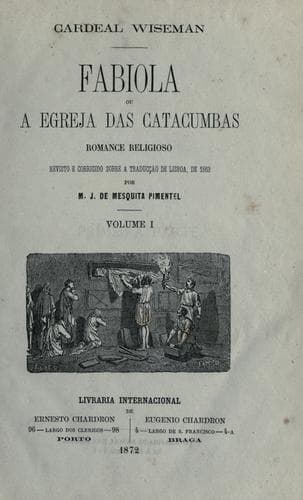
Fabiola; Or, The Church of the CatacombsWiseman, Nicholas Patrick
HistoryHistory
Fabiola; Or, The Church of the Catacombs
Wiseman, Nicholas Patrick
Christian fiction; Church history -- Primitive and early church, ca. 30-600 -- Fiction; Historical fiction
“You will take Sebastian to your quarters; and early to-morrow
morning,--not this evening, mind, for I know that by this time of day
you are all drunk,--but to-morrow morning, when your hands are steady,
you will tie him to a tree in the grove of Adonis, and you will slowly
shoot him to death. Slowly, mind; none of your fine shots straight
through the heart or the brain, but plenty of arrows, till he die
exhausted by pain and loss of blood. Do you understand me? Then take him
off at once. And mind, silence; or else----”
[Illustration: A Monogram of Christ, found in the Catacombs.]
CHAPTER XXV.
THE RESCUE.
In spite of every attempt at concealment, the news was soon spread among
all connected with the court, that Sebastian had been discovered to be a
Christian, and was to be shot to death on the morrow. But on none did
the double intelligence make such an impression as on Fabiola.
Sebastian a Christian! she said to herself; the noblest, purest, wisest
of Rome’s nobility a member of that vile, stupid sect? Impossible! Yet,
the fact seems certain. Have I, then, been deceived? Was he not that
which he seemed? Was he a mean impostor, who affected virtue, but was
secretly a libertine? Impossible, too! Yes, this was indeed impossible!
She had certain proofs of it. He knew that he might have had her hand
and fortune for the asking, and he had acted most generously and most
delicately towards her. He was what he seemed, that she was sure--not
gilded, but gold.
Then how account for this phenomenon, of a Christian being all that was
good, virtuous, amiable?
One solution never occurred to Fabiola’s mind, that he was all this
_because_ he was a Christian. She only saw the problem in another form;
how could he be all that he was _in spite_ of being a Christian?
She turned it variously in her mind, in vain. Then it came to her
thought thus. Perhaps, after all, good old Chromatius was right, and
Christianity may not be what I have fancied; and I ought to have
inquired more about it. I am sure Sebastian never did the horrible
things imputed to Christians. Yet every body charges them with them.
Might there not be a more refined form of this religion, and a more
grovelling one; just as she knew there was in her own sect,
Epicureanism? one coarse, material, wallowing in the very mire of
sensualism; the other refined, sceptical and reflective. Sebastian would
belong to the higher class, and despise and loathe the superstitions and
vices of the commoner Christians. Such a hypothesis might be tenable;
but it was hard to reconcile to her intellect, how a man like that noble
soldier could, any way, have belonged to that hated race. And yet he was
ready to die for their faith! As to Zoë and the others, she had heard
nothing, for she had only returned the day before from a journey made
into Campania, to arrange her father’s affairs.
Public-domain text, read in full here on John Shaqi.
Reviews
Reviews
No reviews yet
Be the first to share your thoughts on this work.
Elsewhere in the archive
Join the Discussion
Join the discussion
Sign in to leave a comment or review.
Sign InorCreate an account