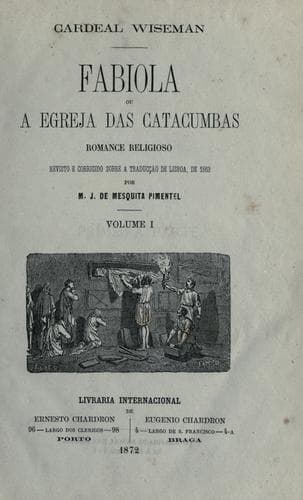
Fabiola; Or, The Church of the CatacombsWiseman, Nicholas Patrick
HistoryHistory
Fabiola; Or, The Church of the Catacombs
Wiseman, Nicholas Patrick
Christian fiction; Church history -- Primitive and early church, ca. 30-600 -- Fiction; Historical fiction
What a pity, she thought, that she had not talked more to Sebastian on
such subjects! But it was now too late; to-morrow morning he would be no
more. This second thought came with the sharp pang of a shaft shot into
her heart. She felt as if she personally were about to suffer a loss, as
if Sebastian’s fate were going to fall on some one closely bound to her,
by some secret and mysterious tie.
Her thoughts grew darker and sadder, as she dwelt on these ideas amidst
the deepening gloom. She was suddenly disturbed by the entrance of a
slave with a light. It was Afra, the black servant, who came to prepare
her mistress’s evening repast, which she wished to take alone. While
busy with her arrangements, she said, “Have you heard the news, madam?”
“What news?”
“Only that Sebastian is going to be shot with arrows to-morrow morning.
What a pity; he was such a handsome youth!”
“Be silent, Afra; unless you have some information to give me on the
subject.”
“Oh, of course, my mistress; and my information is indeed very
astonishing. Do you know that he turns out to be one of those wretched
Christians?”
“Hold your peace, I pray you, and do not prate any more about what you
do not understand.”
“Certainly not, if you so wish it; I suppose his fate is quite a matter
of indifference to you, madam. It certainly is to _me_. He won’t be the
first officer that my countrymen have shot. Many they have killed, and
some they have saved. But of course that was all chance.”
There was a significance in her words and tones, which did not escape
the quick ear and mind of Fabiola. She looked up, for the first time,
and fixed her eyes searchingly on her maid’s swarthy face. There was no
emotion in it; she was placing a flagon of wine upon the table, just as
if she had not spoken. At length the lady said to her:
“Afra, what do you mean?”
“Oh, nothing, nothing. What can a poor slave know? Still more, what can
she do?”
“Come, come, you meant by your words something that I must know.”
The slave came round the table, close to the couch on which Fabiola
rested, looked behind her, and around her, then whispered, “Do you want
Sebastian’s life preserved?”
Fabiola almost leaped up, as she replied, “Certainly.”
The servant put her finger to her lip, to enforce silence, and said, “It
will cost dear.”
“Name your price.”
“A hundred _sestertia_,[184] and my liberty.”
“I accept your terms; but what is my security for them?”
“They shall be binding only if, twenty-four hours after the execution,
he is still alive.”
“Agreed; and what is yours?”
“Your word, lady.”
“Go, Afra, lose not a moment.”
“There is no hurry,” quietly replied the slave, as she completed,
unflurried, the preparations for supper.
She then proceeded at once to the palace, and to the Mauritanian
quarters, and went in directly to the commander.
“What dost thou want, Jubala,” he said, “at this hour? There is no
festival to-night.”
“I know, Hyphax; but I have important business with thee.”
Public-domain text, read in full here on John Shaqi.
Reviews
Reviews
No reviews yet
Be the first to share your thoughts on this work.
Elsewhere in the archive
Join the Discussion
Join the discussion
Sign in to leave a comment or review.
Sign InorCreate an account