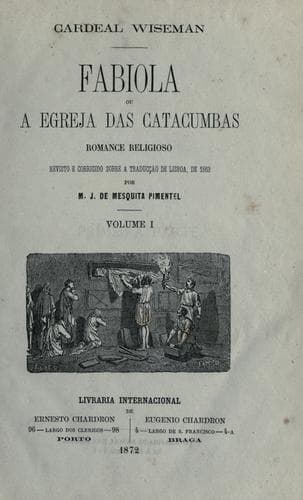
Fabiola; Or, The Church of the CatacombsWiseman, Nicholas Patrick
HistoryHistory
Fabiola; Or, The Church of the Catacombs
Wiseman, Nicholas Patrick
Christian fiction; Church history -- Primitive and early church, ca. 30-600 -- Fiction; Historical fiction
Sebastian, in the meantime, was unconscious of these amiable
negotiations for his safety; for, like Peter between two guards, he was
slumbering soundly by the wall of the court. Fatigued with his day’s
work, he had enjoyed the rare advantage of retiring early to rest; and
the marble pavement was a good enough soldier’s bed. But, after a few
hours’ repose, he awoke refreshed; and now that all was hushed, he
silently rose, and with outstretched arms, gave himself up to prayer.
The martyr’s prayer is not a preparation for death; for his is a death
that needs no preparation. The soldier who suddenly declares himself a
Christian, bends down his head, and mingles his blood with that of the
confessor, whom he had come to execute; or the friend, of unknown name,
who salutes the martyr going to death, is seized, and made to bear him
willing company,[186] is as prepared for martyrdom, as he who has passed
months in prison engaged in prayer. It is not a cry, therefore, for the
forgiveness of past sin; for there is a consciousness of that perfect
love, which sendeth out fear, an inward assurance of that highest grace,
which is incompatible with sin.
Nor in Sebastian was it a prayer for courage or strength; for the
opposite feeling, which could suggest it, was unknown to him. It never
entered into his mind to doubt, that as he had faced death intrepidly
for his earthly sovereign on the battle-field, so he should meet it
joyfully for his heavenly Lord, in any place.
His prayer, then, till morning, was a gladsome hymn of glory and honor
to the King of kings, a joining with the seraph’s glowing eyes, and
ever-shaking wings, in restless homage.
Then when the stars in the bright heavens caught his eyes, he challenged
them as wakeful sentinels like himself, to exchange the watchword of
Divine praises; and as the night-wind rustled in the leafless trees of
the neighboring court of Adonis, he bade its wayward music compose
itself, and its rude harping upon the vibrating boughs form softer
hymns,--the only ones that earth could utter in its winter night-hours.
Now burst on him the thrilling thought that the morning hour approached,
for the cock had crowed; and he would soon hear those branches murmuring
over him to the sharp whistle of flying arrows, unerring in their aim.
And he offered himself gladly to their sharp tongues, hissing as the
serpent’s, to drink his blood. He offered himself as an oblation for
God’s honor, and for the appeasing of his wrath. He offered himself
particularly for the afflicted Church, and prayed that his death might
mitigate her sufferings.
Public-domain text, read in full here on John Shaqi.
Reviews
Reviews
No reviews yet
Be the first to share your thoughts on this work.
Elsewhere in the archive
Join the Discussion
Join the discussion
Sign in to leave a comment or review.
Sign InorCreate an account