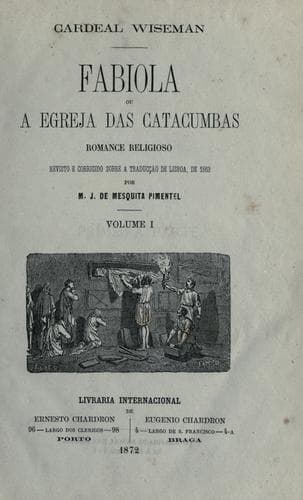
Fabiola; Or, The Church of the CatacombsWiseman, Nicholas Patrick
HistoryHistory
Fabiola; Or, The Church of the Catacombs
Wiseman, Nicholas Patrick
Christian fiction; Church history -- Primitive and early church, ca. 30-600 -- Fiction; Historical fiction
“What is it about?”
“About thee, about myself, and about thy prisoner.”
“Look at _him_ there,” said the barbarian, pointing across the court,
which his door commanded. “You would not think that _he_ is going to be
shot to-morrow. See how soundly he sleeps. He could not do so better, if
he were going to be married instead.”
“As thou and I, Hyphax, intend to be the next day.”
“Come, not quite so fast; there are certain conditions to be fulfilled
first.”
“Well, what are they?”
“First, thy manumission. I cannot marry a slave.”
“That is secured.”
“Secondly, a dowry, a _good_ dowry, mind; for I never wanted money more
than now.”
“That is safe too. How much dost thou expect?”
“Certainly not less than three hundred pounds.”[185]
“I bring thee six hundred.”
“Excellent! where didst thou get all this cash? Whom hast thou robbed?
whom hast thou poisoned, my admirable priestess? Why wait till _after_
to-morrow? Let it be to-morrow, to-night, if it please thee.”
“Be quiet now, Hyphax; the money is all lawful gain; but it has its
conditions, too. I said I came to speak about the prisoner also.”
“Well, what has he to do with our approaching nuptials?”
“A great deal.”
“What now?”
“He must not die.”
The captain looked at her with a mixture of fury and stupidity. He
seemed on the point of laying violent hands on her; but she stood
intrepid and unmoved before him, and seemed to command him by the strong
fascination of her eye, as one of the serpents of their native land
might do a vulture.
“Art mad?” he at last exclaimed; “thou mightest as well at once ask for
my head. If thou hadst seen the emperor’s face, when he issued his
orders, thou wouldst have known he will have no trifling with him here.”
“Pshaw! pshaw! man; of course the prisoner will appear dead, and will be
reported as dead.”
“And if he finally recover?”
“His fellow-Christians will take care to keep him out of the way.”
“Didst thou say twenty-four hours alive? I wish thou hadst made it
twelve.”
“Well, but I know that thou canst calculate close. Let him die in the
twenty-fifth hour, for what I care.”
“It is impossible, Jubala, impossible; he is too important a person.”
“Very well, then; there is an end to our bargain. The money is given
only on this condition. Six hundred pounds thrown away!” And she turned
off to go.
“Stay, stay,” said Hyphax, eagerly; the demon of covetousness coming
uppermost. “Let us see. Why, my fellows will consume half the money, in
bribes and feasting.”
“Well, I have two hundred more in reserve for that.”
“Sayest thou so, my princess, my sorceress, my charming demon? But that
will be too much for my scoundrels. We will give them half, and add the
other half--to our marriage-settlements, shan’t we?”
“As it pleases thee, provided the thing is done according to my
proposal.”
“It is a bargain, then. He shall live twenty-four hours; and after that,
we will have a glorious wedding.”
Public-domain text, read in full here on John Shaqi.
Reviews
Reviews
No reviews yet
Be the first to share your thoughts on this work.
Elsewhere in the archive
Join the Discussion
Join the discussion
Sign in to leave a comment or review.
Sign InorCreate an account