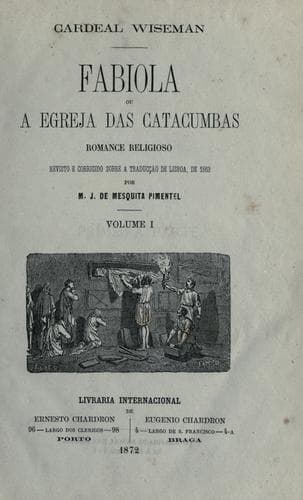
Fabiola; Or, The Church of the CatacombsWiseman, Nicholas Patrick
HistoryHistory
Fabiola; Or, The Church of the Catacombs
Wiseman, Nicholas Patrick
Christian fiction; Church history -- Primitive and early church, ca. 30-600 -- Fiction; Historical fiction
The first Moor drew his bow-string to his ear, and an arrow trembled in
the flesh of Sebastian. Each chosen marksman followed in turn; and
shouts of applause accompanied each hit, so cleverly approaching, yet
avoiding, according to the imperial order, every vital part. And so the
game went on; every body laughing, and brawling, and jeering, and
enjoying it without a particle of feeling for the now drooping frame,
painted with blood;[187] all in sport, except the martyr, to whom all
was sober earnest--each sharp pang, the enduring smart, the exhaustion,
the weariness, the knotty bonds, the constrained attitude! Oh! but
earnest too was the steadfast heart, the untiring spirit, the unwavering
faith, the unruffled patience, the unsated love of suffering for his
Lord. Earnest was the prayer, earnest the gaze of the eye on heaven,
earnest the listening of the ear for the welcoming strain of the
heavenly porters, as they should open the gate.
It was indeed a dreary death; yet this was not the worst. After all,
death came not; the golden gates remained unbarred; the martyr in heart,
still reserved for greater glory even upon earth, found himself, not
suddenly translated from death to life, but sunk into unconsciousness in
the lap of angels. His tormentors saw when they had reached their
intended measure; they cut the cords that bound him; and Sebastian fell
exhausted, and to all appearance dead, upon the carpet of blood which he
had spread for himself on the pavement. Did he lie, like a noble
warrior, as he now appears in marble under his altar, in his own dear
church? We at least cannot imagine him as more beautiful. And not only
that church do we love, but that ancient chapel which stands in the
midst of the ruined Palatine, to mark the spot on which he fell.[188]
[Illustration: Elias carried up to Heaven, from a picture found in the
Catacombs.]
CHAPTER XXVI.
THE REVIVAL.
Night was far advanced, when the black slave, having completed her
marriage settlement quite to her own satisfaction, was returning to her
mistress’s house. It was, indeed, a cold wintry night, so she was well
wrapped up, and in no humor to be disturbed. But it was a lovely night,
and the moon seemed to be stroking, with a silvery hand, the downy robe
of the _meta sudans_.[189] She paused beside it; and, after a silence of
some moments, broke out into a loud laugh, as if some ridiculous
recollection connected itself in her mind with that beautiful object.
She was turning round to proceed on her way, when she felt herself
roughly seized by the arm.
“If you had not laughed,” said her captor, bitterly, “I should not have
recognized you. But that hyena laugh of yours is unmistakable. Listen,
the wild beasts, your African cousins, are answering it from the
amphitheatre. What was it about, pray?”
“About you.”
“How about me?”
“I was thinking of our last interview in this place, and what a fool you
made of yourself.”
Public-domain text, read in full here on John Shaqi.
Reviews
Reviews
No reviews yet
Be the first to share your thoughts on this work.
Elsewhere in the archive
Join the Discussion
Join the discussion
Sign in to leave a comment or review.
Sign InorCreate an account